











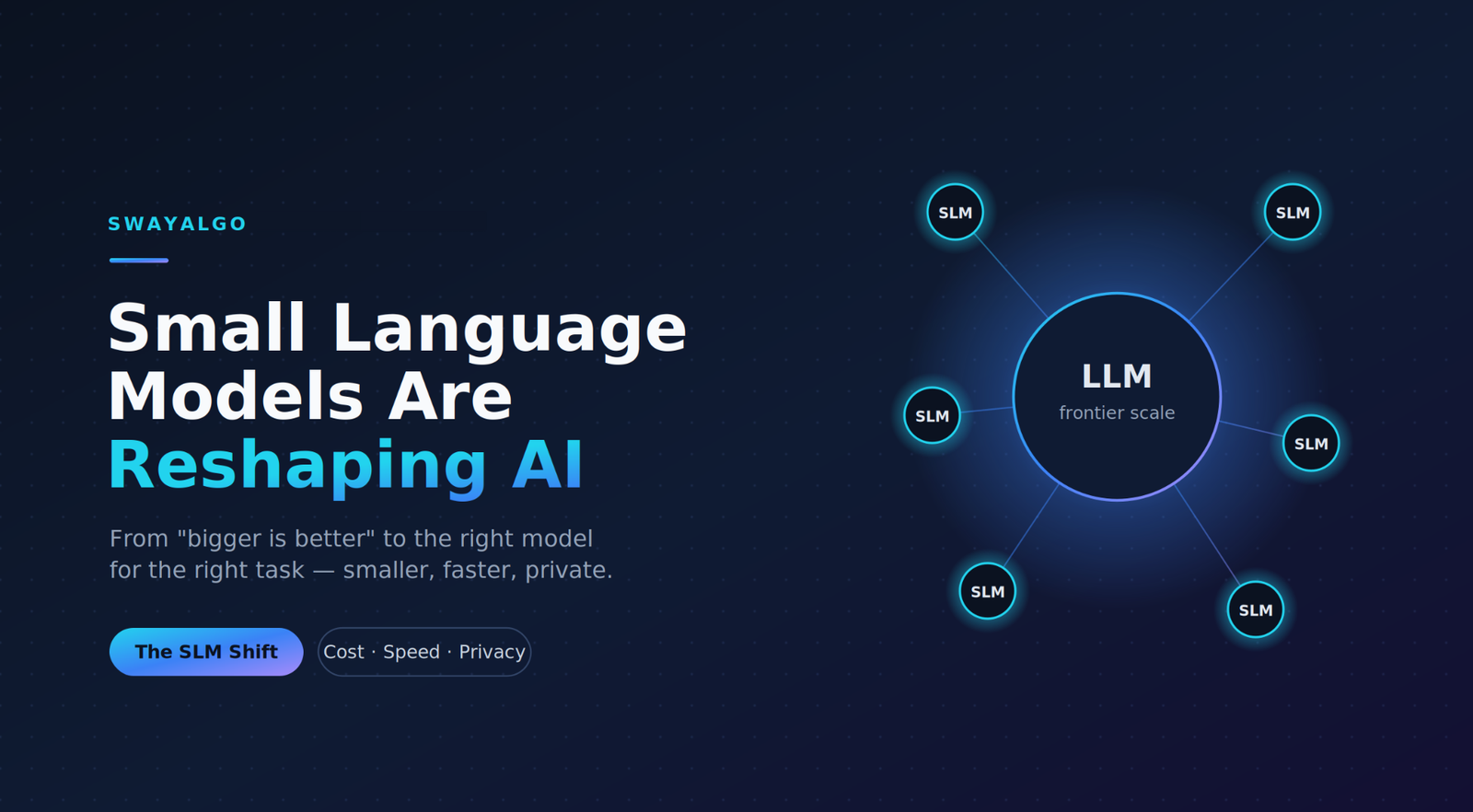
For the past few years, progress in artificial intelligence has been measured by a single question: Whose model is bigger? Each new generation of Large Language Models (LLMs) arrived with more parameters, larger training budgets, and broader general capabilities. But as organizations move from AI experimentation to real-world production systems, a quieter shift is taking place—one that trades raw scale for precision, efficiency and control. At SwayAlgo Technologies, we see this shift clearly in the field. Enterprises are no longer asking only, “Which model is the most powerful?” They are increasingly asking: “Which model is the fastest, cheapest, most private and best suited to my specific task?” Increasingly, the answer is a Small Language Model (SLM). Small Language Models are compact, efficient models—typically ranging from a few hundred million to around ten billion parameters—engineered to run on limited hardware while delivering strong performance on focused tasks. They sacrifice some general breadth compared to frontier LLMs, but they can deliver significant advantages in speed, cost, privacy and deployability. This is not a rejection of LLMs. It represents a maturing of how the industry approaches AI. Rethinking “Bigger vs Smarter” The “bigger is better” philosophy delivered remarkable breakthroughs, but it also introduced...