

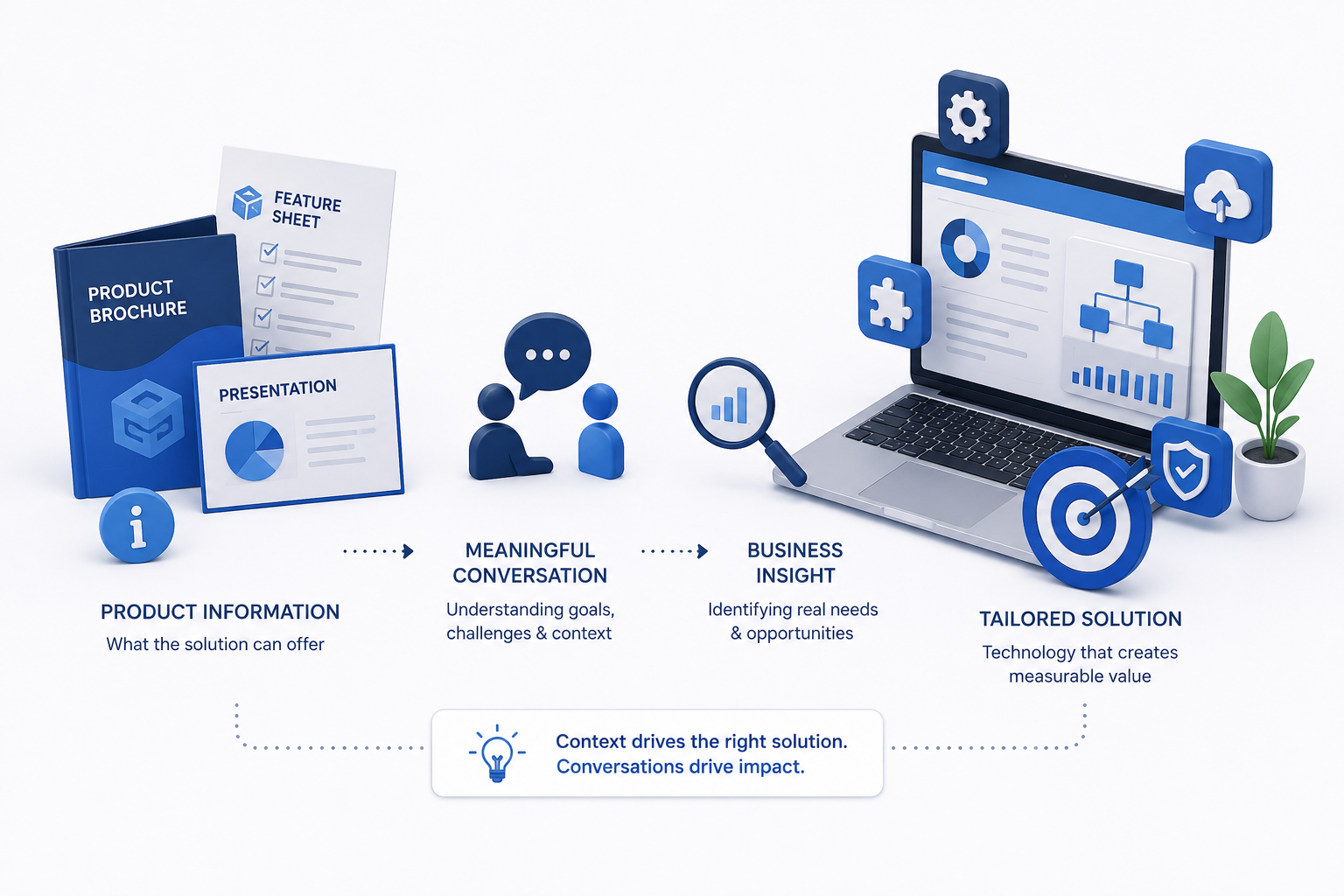
In technology-driven businesses, product brochures, presentations, feature sheets and marketing materials are often used to communicate what a solution can offer. They provide information about capabilities, technologies, integrations and potential use cases. However, information alone does not always explain what a business actually needs.
Every organization operates differently. Its processes, challenges, existing systems, customers, teams and growth objectives influence the way technology should be implemented. A feature that is valuable for one organization may have little relevance to another. This is why understanding the business context is often more important than simply presenting a list of product capabilities.
A meaningful conversation with a business can reveal these requirements in a way that no brochure can. Through discussions with stakeholders, technology teams can understand existing workflows, identify operational challenges and determine where technology can create measurable value.
Understanding the Business Before the Solution
Technology decisions should begin with understanding the problem rather than immediately discussing the solution.
A business may approach a technology company looking for an ERP system, automation platform, IoT solution, custom application or AI-based system. However, the initial requirement is often only a part of the larger problem.
For example, a company may ask for an automated reporting system because employees spend significant time preparing reports manually. A deeper conversation may reveal that the real challenge is fragmented data across multiple systems, inconsistent processes or the absence of a centralized data structure.
Understanding this distinction is important.
Instead of simply delivering the requested feature, a technology partner can evaluate the underlying process and determine the most appropriate solution.
Why Conversations Reveal More Than Requirements Documents
Requirement documents are useful for defining functionality, but conversations provide context.
During a business discussion, stakeholders can explain how a process actually works, where delays occur, which activities require manual intervention and what problems employees experience on a daily basis.
These conversations can uncover:
- Operational bottlenecks
- Repetitive manual processes
- Data accessibility issues
- Integration challenges
- Existing technology limitations
- Business priorities
- Future scalability requirements
- Expectations from different stakeholders
This information helps technology teams move from feature-based thinking to problem-based thinking.
A solution should not simply satisfy a list of requirements. It should fit into the organization’s existing ecosystem and support the way the business operates.
From Product Features to Business Outcomes
A product brochure generally answers the question:
“What can this product do?”
A business conversation answers a more important question:
“What does the business need to achieve?”
The difference is significant.
A system may have dozens of features, but if those features do not address the organization’s most important challenges, the technology investment may not deliver the expected value.
For example, automation is not valuable simply because a process has been automated. Its real value comes from reducing processing time, minimizing errors, improving visibility or allowing employees to focus on higher-value activities.
Similarly, implementing an analytics platform is not the end goal. The objective is to help decision-makers access relevant information and make better decisions.
Technology becomes meaningful when its capabilities are connected to measurable business outcomes.
Building the Right Technology Around the Business
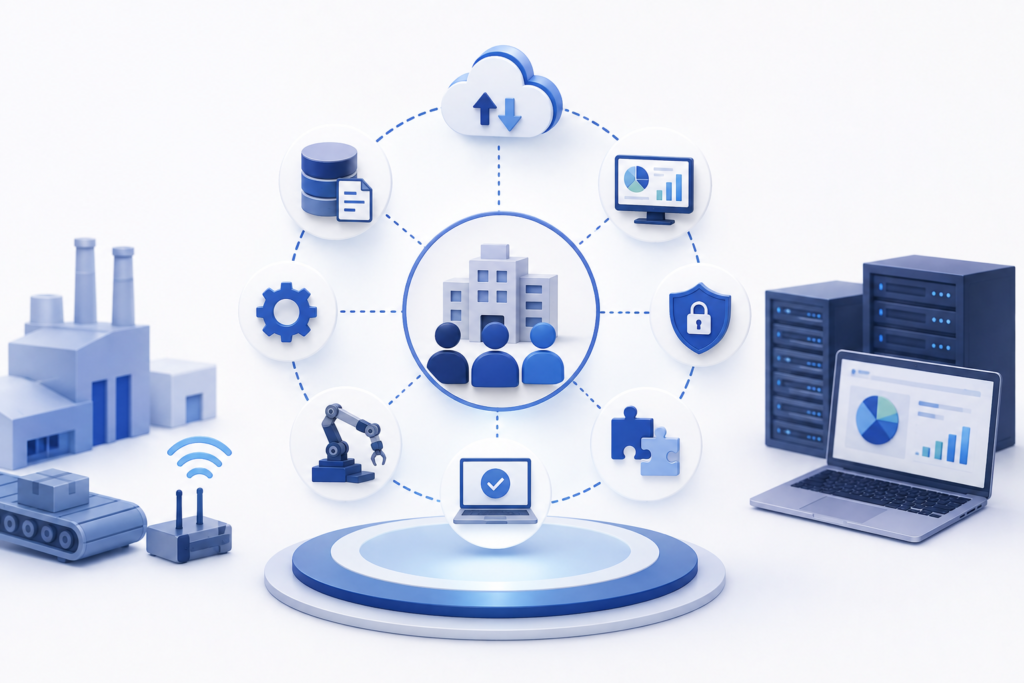
Every organization has a different technology environment.
Some businesses operate with legacy systems, while others have modern cloud-based platforms. Some may require integration with machines and IoT devices, while others may need enterprise applications, workflow automation or custom software.
A detailed business conversation helps identify these dependencies before implementation begins.
Understanding the existing environment allows technology teams to evaluate:
- Existing applications and infrastructure
- Data sources and formats
- Integration requirements
- User roles and workflows
- Security and access requirements
- Scalability expectations
- Reporting and analytics needs
- Future technology requirements
This approach reduces the risk of building a solution that works technically but does not work effectively within the business.
The Value of Asking the Right Questions
Effective technology consulting is not only about explaining solutions. It is also about asking the right questions.
Questions such as:
How does this process work today?
Where does the team spend the most time?
What happens when something goes wrong?
Which systems are currently involved?
What information is difficult to access?
What would you like this process to look like in the future?
These questions often provide more useful information than a standard product presentation.
They help identify the difference between the current state and the desired state, which becomes the foundation for designing an appropriate technology solution.
From Conversation to Solution Architecture
Once the business requirements and challenges are understood, technology discussions can become more focused.
Instead of starting with a predefined product, teams can evaluate different approaches based on the business context. This could involve customization of an existing platform, integration between multiple systems, development of a custom application, implementation of automation or adoption of AI and IoT technologies.
The conversation therefore becomes the starting point for solution architecture.
A well-understood business problem can lead to a solution that is:
- Aligned with business processes
- Easier to integrate
- Scalable for future requirements
- Practical for users
- More efficient to maintain
- Focused on measurable outcomes
How SwayAlgo Approaches Technology Discussions
At SwayAlgo, technology discussions begin with understanding the business problem, its existing processes and the outcomes the organization wants to achieve.
Rather than approaching every requirement with a predefined solution, the focus is on understanding the context first. This allows the team to evaluate where technologies such as AI, IoT, ERP, automation, embedded systems and custom software can provide practical value.
The objective is not simply to implement technology, but to build solutions that fit the business environment and support long-term operational and strategic goals.
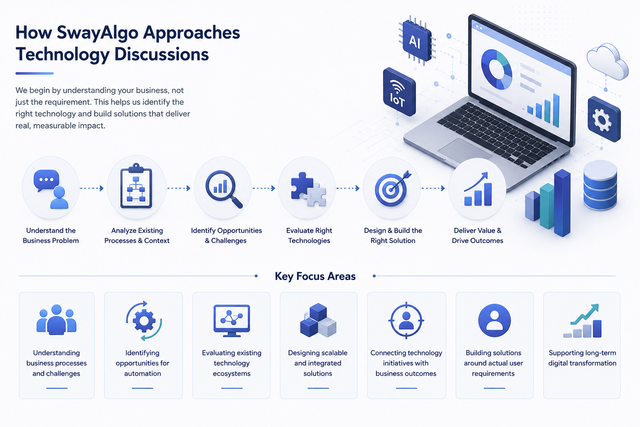
Key Focus Areas
- Understanding business processes and challenges
- Identifying opportunities for automation
- Evaluating existing technology ecosystems
- Designing scalable and integrated solutions
- Connecting technology initiatives with business outcomes
- Building solutions around actual user requirements
- Supporting long-term digital transformation
Conclusion
Product brochures can explain capabilities, technologies and features, but they cannot fully explain how a business operates.
A conversation can.
Understanding the processes behind a requirement, the challenges faced by teams, and the outcomes expected from technology provides a stronger foundation for solution design. It enables technology teams to move beyond simply delivering features and focus on creating solutions that address real business problems.
In a rapidly evolving technology landscape, the most valuable starting point may not be another product presentation.
It may simply be a conversation.