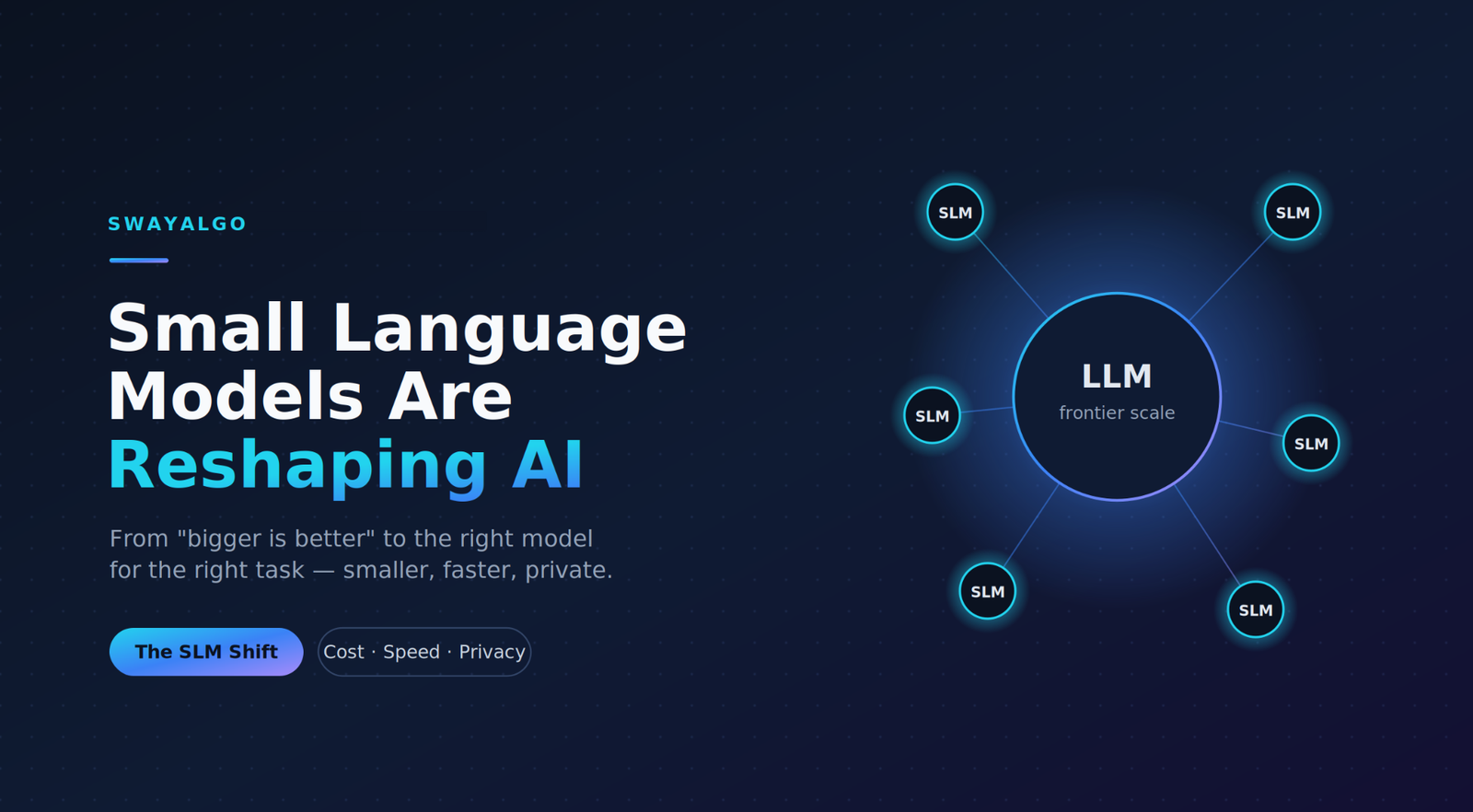

For the past few years, progress in artificial intelligence has been measured by a single question: Whose model is bigger?
Each new generation of Large Language Models (LLMs) arrived with more parameters, larger training budgets, and broader general capabilities. But as organizations move from AI experimentation to real-world production systems, a quieter shift is taking place—one that trades raw scale for precision, efficiency and control.
At SwayAlgo Technologies, we see this shift clearly in the field. Enterprises are no longer asking only, “Which model is the most powerful?” They are increasingly asking:
“Which model is the fastest, cheapest, most private and best suited to my specific task?”
Increasingly, the answer is a Small Language Model (SLM).
Small Language Models are compact, efficient models—typically ranging from a few hundred million to around ten billion parameters—engineered to run on limited hardware while delivering strong performance on focused tasks. They sacrifice some general breadth compared to frontier LLMs, but they can deliver significant advantages in speed, cost, privacy and deployability.
This is not a rejection of LLMs. It represents a maturing of how the industry approaches AI.
Rethinking “Bigger vs Smarter”
The “bigger is better” philosophy delivered remarkable breakthroughs, but it also introduced significant operational challenges for businesses. Running a large, general-purpose model for every task means paying a computational cost for work that a smaller, specialized model could often handle efficiently.
A significant share of enterprise AI workloads involve narrow, repetitive tasks such as:
- Classification
- Data extraction
- Routing
- Summarization
- Information transformation
- Structured response generation
For these workloads, a tuned SLM can deliver faster responses at a fraction of the cost.
The industry is therefore moving from:
“Which model has the most parameters?”
to:
“Which model is best suited to this specific task?”
This leads to several practical questions:
- Which model matches the specific workload?
- What are the actual cost and latency requirements?
- Where does the data need to reside?
- How much general-purpose knowledge does the workload actually require?
- Can the task be handled locally or on-premises?
This reframing is at the heart of the SLM movement.
Success in AI is increasingly measured not by which model you use, but by how effectively you match models to tasks.
The Economics of Going Small
Cost is often the first factor that pushes organizations toward SLMs.
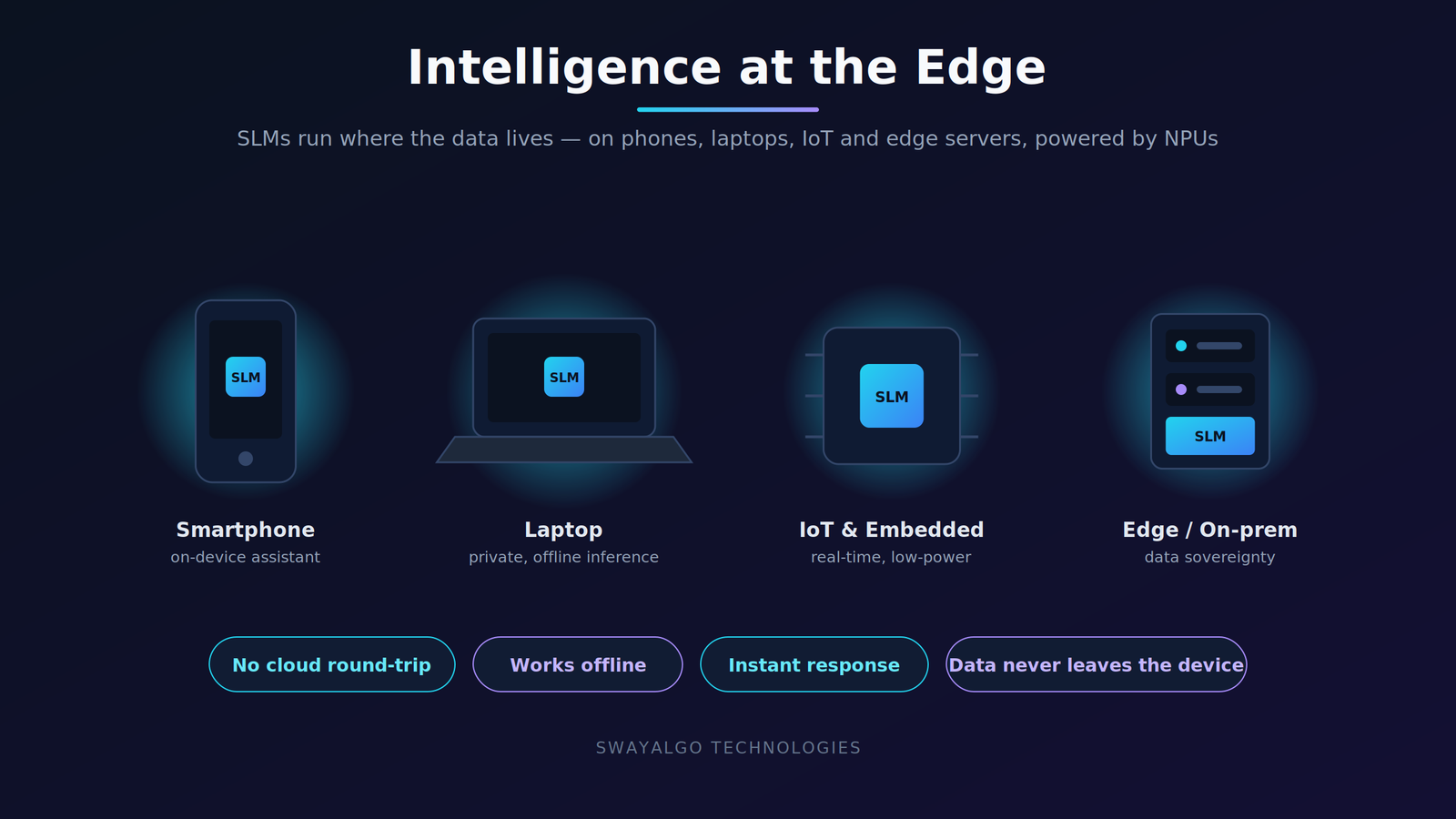
At scale, cloud API pricing for very large models can add up quickly. Heavy usage can result in significant and sometimes unpredictable monthly expenses.
Smaller models can fundamentally change this equation.
Key Economic Advantages
- Lower inference and GPU costs
- Near-zero variable inference costs when deployed on owned infrastructure
- Faster and less expensive fine-tuning cycles
- Reduced energy consumption and infrastructure requirements
- Lower barriers to AI adoption for SMEs and smaller teams
Serving a compact model can be significantly cheaper than running a frontier-scale model for the same high-volume workload.
For repetitive enterprise tasks, this cost difference can determine whether an AI feature is economically viable.
Privacy, Data Sovereignty and Compliance
For regulated industries, cost is only part of the equation.
Control over data is often the deciding factor.
Sending sensitive information to a third-party cloud model may not be acceptable for organizations operating in sectors such as:
- Healthcare
- Banking and financial services
- Legal services
- Government
- Defense
- Manufacturing
SLMs can be deployed on-premises, within private clouds or directly on edge devices, allowing organizations to keep sensitive data within their own infrastructure boundaries.
This Enables:
- On-device and on-premises inference
- Reduced exposure to third-party and multi-tenant risks
- Improved control over data residency
- Greater auditability and governance
- Stronger control over AI workloads and data flows
For enterprises that cannot afford data leakage, a capable model that they fully control can be more valuable than a slightly more capable model that requires external infrastructure.
Speed, Latency and On-Device Intelligence
Many real-world applications are interactive and users notice latency immediately.
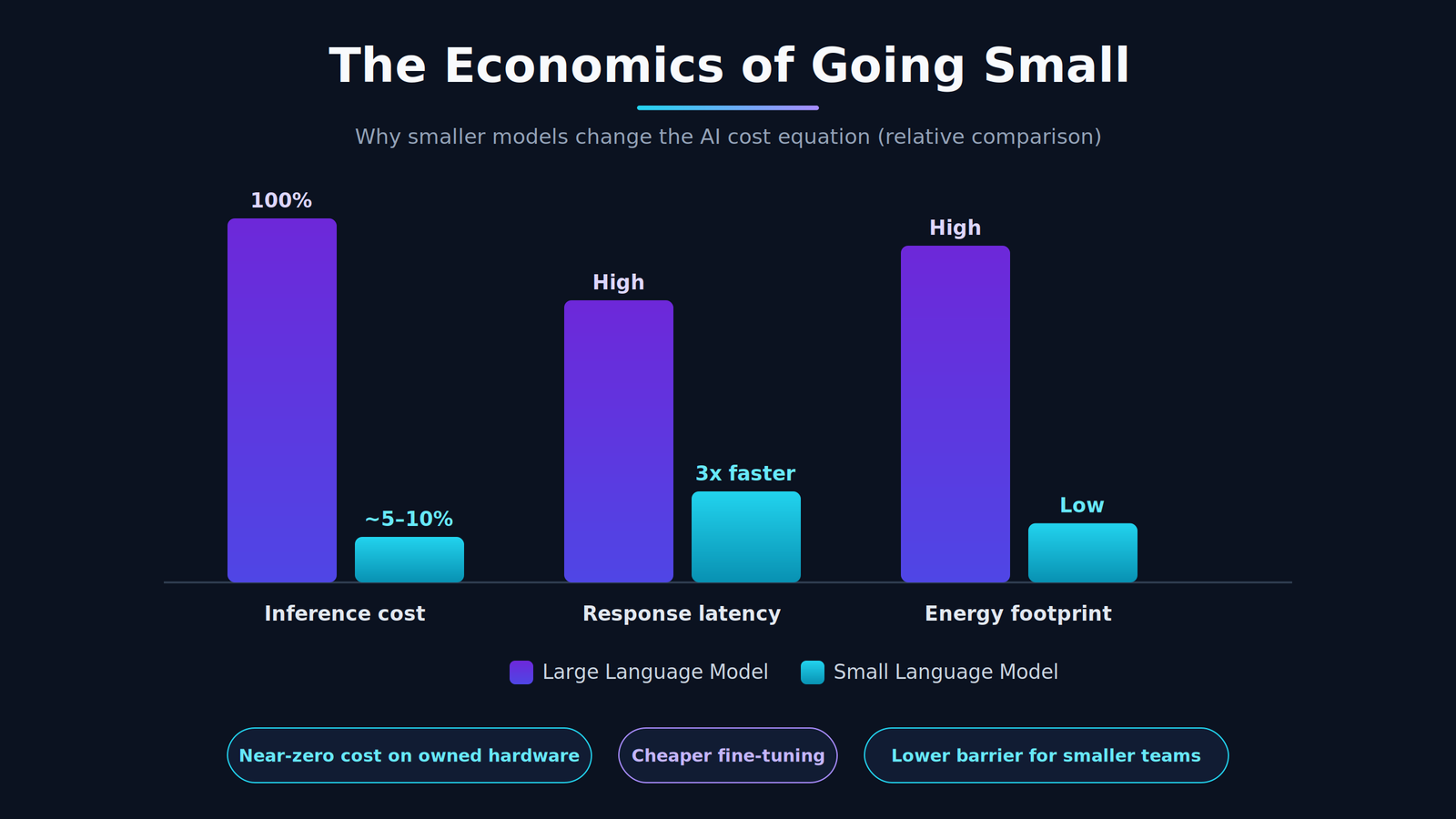
Cloud round-trips to very large models can introduce delays that negatively affect real-time experiences. Smaller models running closer to the user—on a laptop, smartphone, server or edge device—can dramatically reduce this latency.
Modern hardware is accelerating this trend.
Why On-Device AI Is Becoming Practical
- Neural Processing Units (NPUs) are increasingly available in laptops and smartphones
- More devices can run capable local AI models
- Edge deployment reduces dependence on continuous connectivity
- Lower latency enables responsive real-time applications
- Local execution allows applications to continue functioning offline
- Sensitive information can remain on the device
On-device AI is no longer purely experimental.
It is becoming an increasingly important layer of modern software, and SLMs are helping make that transition practical.
Domain Specialization Beats General Breadth
A large model can know something about almost everything.
But most business applications do not need a model that knows everything. They need a model that knows a lot about one specific thing.
This is where SLMs can shine.
When fine-tuned or adapted using focused, domain-specific data, a smaller model can perform extremely well on the task it was designed for.
Common SLM Applications
- Document processing and structured data extraction
- Ticket classification and intelligent routing
- Contract and clause identification
- Transaction analysis and fraud detection
- Clinical documentation and record population
- Customer support for specialized domains
- Enterprise workflow classification
- Internal knowledge and process assistants
By narrowing the scope, organizations can gain accuracy, consistency, predictability and efficiency without paying the operational cost of a much larger general-purpose model.
SLMs and the Rise of Agentic AI
Autonomous AI agents are changing how software gets work done—and they are also changing how organizations should think about model selection.
Agentic systems often break complex objectives into many smaller steps, such as:
- Understanding the next action
- Selecting the appropriate tool
- Formatting a request
- Calling an API
- Parsing a response
- Validating the result
- Retrying when necessary
- Passing the output to the next step
Not every step requires frontier-scale reasoning.
Many require fast, reliable, predictable and low-cost execution—exactly where SLMs can provide value.
An SLM-First Agentic Architecture Can Enable:
- Lower-cost execution of high-frequency agent steps
- Faster tool calling and workflow orchestration
- More predictable behavior within defined boundaries
- Lower operational overhead for always-on agents
- Modular AI systems where specialized models handle specific tasks
The emerging pattern resembles the philosophy behind microservices:
Many small, task-focused components working together rather than one monolithic system doing everything.
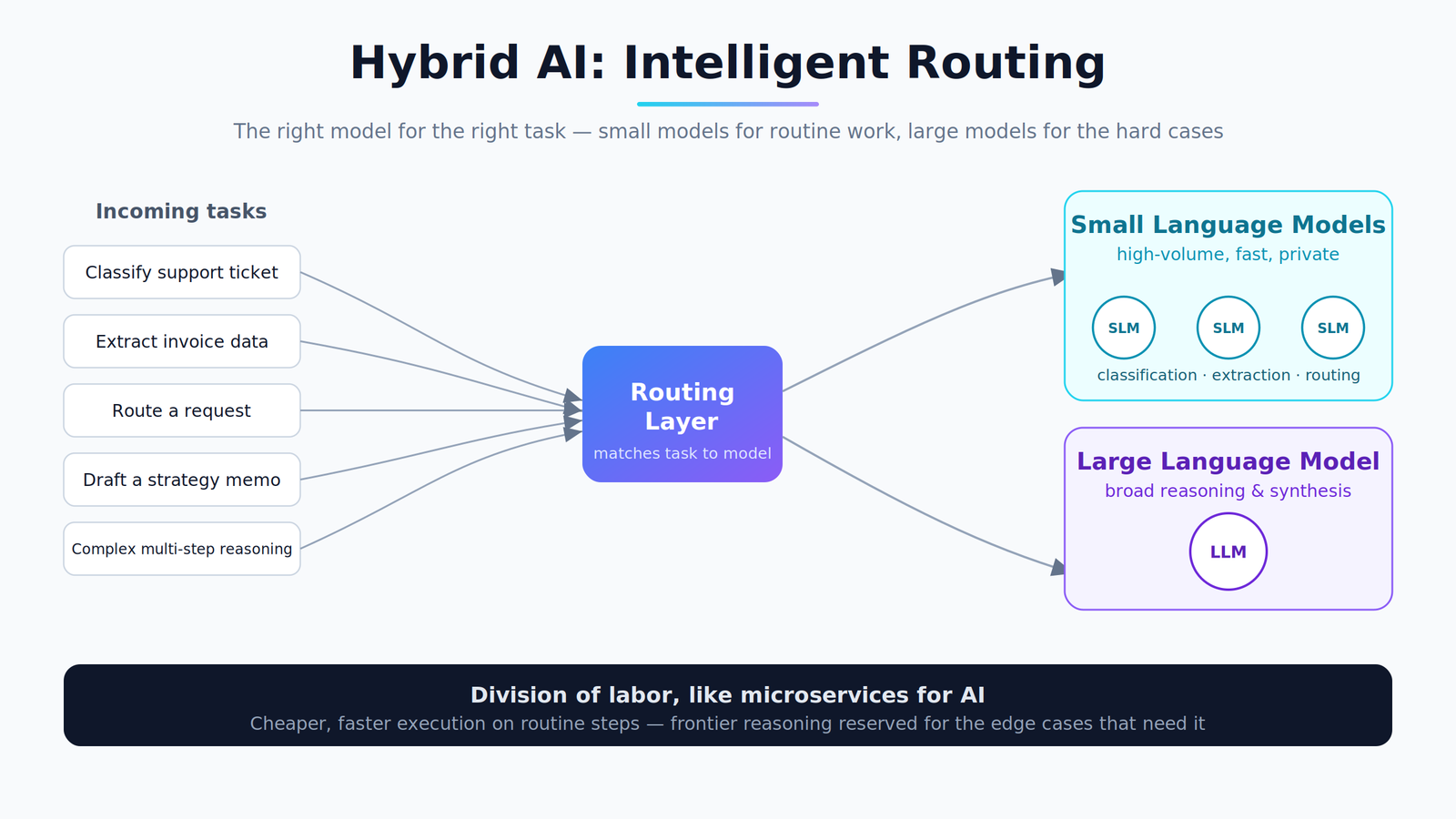
The Future Is Hybrid, Not Either-Or
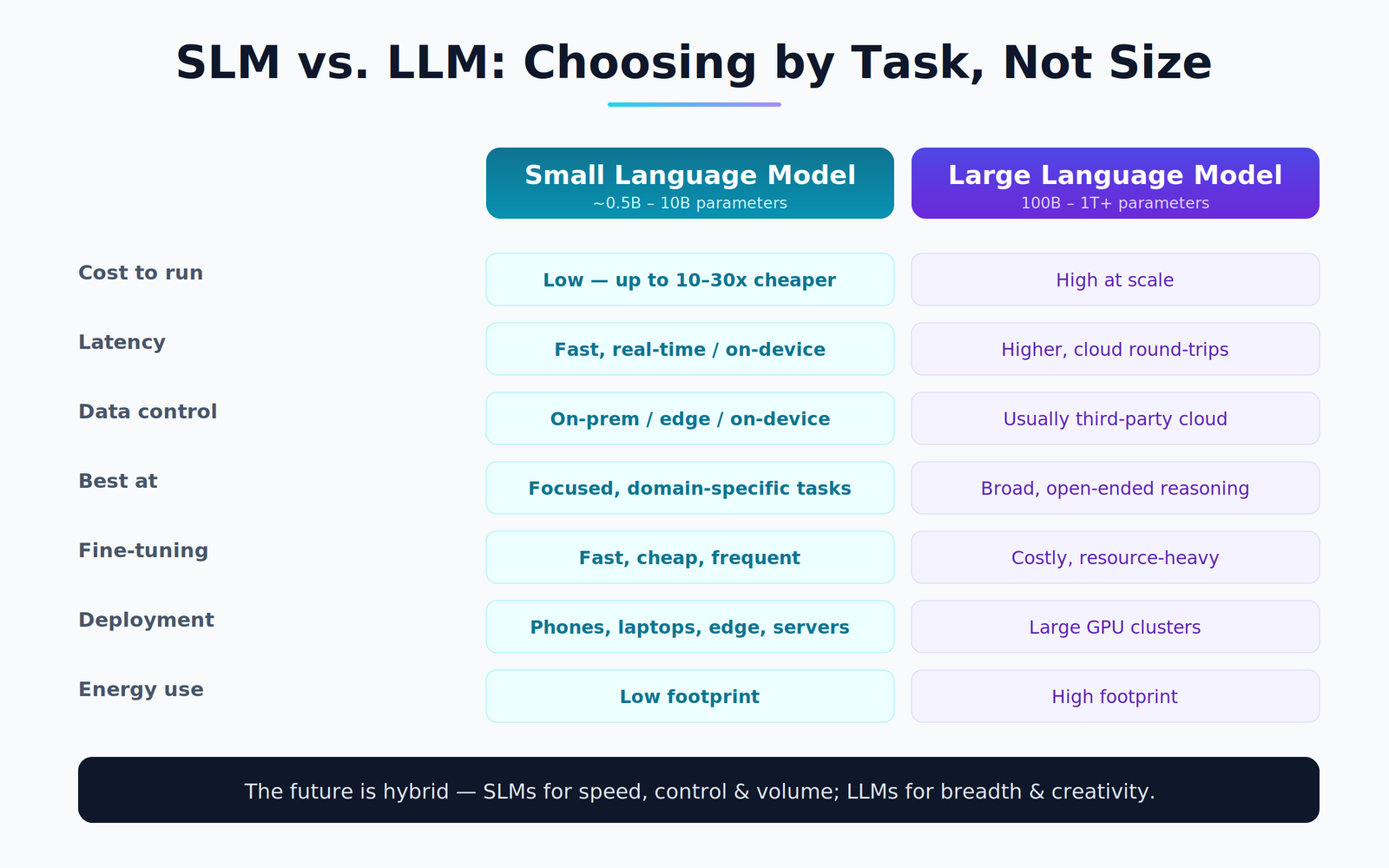
The rise of SLMs does not mean the end of LLMs.
In fact, the most effective enterprise AI architectures will often combine both.
The principle is simple:
Use the right model for the right task.
SLMs can handle speed, cost, control and privacy-sensitive workloads, while larger models can handle abstraction, synthesis, creativity and complex reasoning.
A Well-Designed Hybrid Strategy Can Include:
- Intelligent routing between small and large models
- SLMs for high-volume and latency-sensitive workloads
- LLMs for complex reasoning and open-ended tasks
- Retrieval-Augmented Generation (RAG) to provide domain-specific knowledge
- Multi-model workflows optimized around business requirements
- Fallback mechanisms that escalate complex requests to larger models
This division of labor allows organizations to optimize cost, performance, security and capability without relying on a single model for everything.
How SwayAlgo Approaches Small Language Models
At SwayAlgo Technologies, we take a pragmatic, task-first approach to SLM adoption. Our objective is to help organizations move from AI experimentation to production while balancing:
Capability | Cost | Privacy | Performance | Governance
Rather than defaulting to the largest available model, we identify where a smaller, specialized model can deliver better ROI.
We then design architectures that combine SLMs, LLMs, intelligent routing, RAG and workflow orchestration across cloud, on-premises, and edge environments.
Our focus is on:
- Matching models to specific business tasks
- Building repeatable AI deployment pipelines
- Benchmarking models against real workloads
- Optimizing inference performance and cost
- Establishing governance for responsible AI adoption
- Creating architectures that can scale with business requirements
Key Focus Areas
1. Use-Case Assessment
Identify high-ROI opportunities where SLMs can replace expensive or unnecessarily large models.
2. Model Selection & Benchmarking
Evaluate open and proprietary SLMs based on accuracy, latency, cost, hardware requirements and task performance.
3. Domain-Specific Fine-Tuning
Adapt models using secured enterprise datasets to improve performance on specialized workflows.
4. On-Premises & Edge Deployment
Deploy models within private infrastructure or directly on edge devices to support data sovereignty and offline operation.
5. Hybrid AI Architectures
Build intelligent routing systems that dynamically select between SLMs and LLMs based on workload requirements.
6. Retrieval-Augmented Generation
Extend SLM capabilities with enterprise knowledge while keeping responses grounded in controlled data sources.
7. MLOps & Model Lifecycle Management
Establish pipelines for model versioning, evaluation, deployment, monitoring and continuous improvement.
8. AI Governance
Implement controls covering privacy, security, compliance, model evaluation and responsible AI usage.
9. Cost & Performance Optimization
Optimize inference workloads for throughput, latency, infrastructure utilization and total cost of ownership.
10. Agentic & Workflow Integration
Integrate SLMs into AI agents and workflow-driven systems where speed, reliability and predictable behavior are critical.
Conclusion
For the past few years, one of the defining questions in AI has been:
“Whose model has more parameters?”
In 2026, enterprises are asking a more practical question:
“For my specific scenario, which model is cheapest, fastest, most private and best at understanding my domain?”
Increasingly, the answer points toward Small Language Models.
At SwayAlgo Technologies, we see SLMs not as a downgrade from frontier AI, but as a recalibration of how AI should be deployed—a shift from raw scale toward precision, efficiency, specialization and control.
Organizations that successfully adopt this approach can do more than reduce costs. They can gain a durable advantage through:
- Faster AI experiences
- Greater data control
- Better domain specialization
- More predictable AI operations
- Lower infrastructure costs
- More scalable AI architectures
The future of enterprise AI is hybrid.
It is about choosing the right model, fine-tuning it for the right task and deploying it where it makes the most economic and strategic sense.
Small Language Models are not going to replace the LLM world.
They are going to reshape it—helping transform AI from an expensive experiment into a dependable, efficient and everyday foundation for real business value.