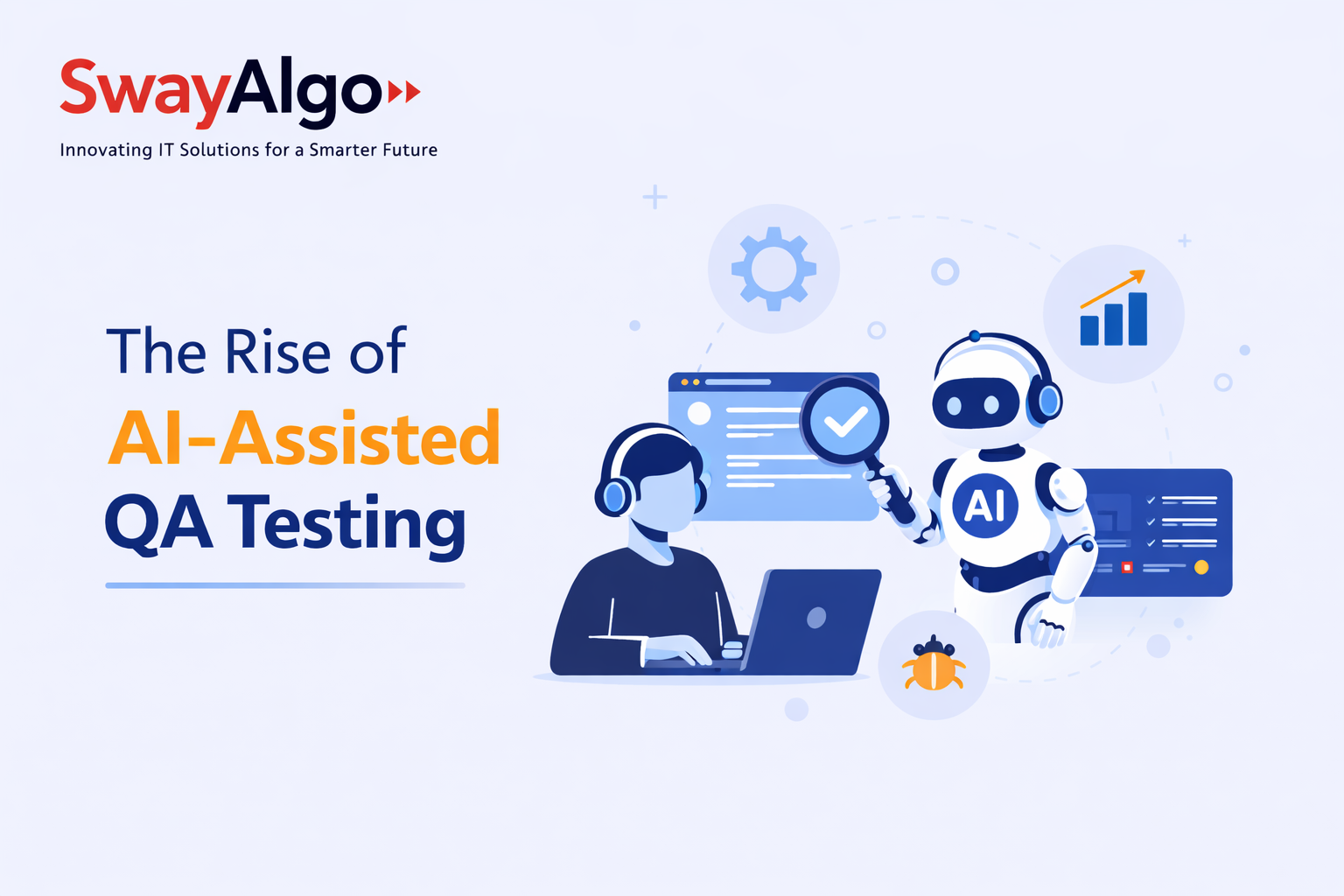
Quality Assurance (QA) has traditionally been a structured and documentation-heavy process. Test cases are written manually, automation frameworks are carefully designed and test cycles follow strict workflows. While this approach ensures stability, it can slow down development in fast-moving engineering environments. With the emergence of AI-assisted development and vibe coding, QA testing is evolving into a faster, more adaptive process. Testers can now generate scripts, experiment with scenarios and debug issues rapidly with the help of intelligent tools. This shift allows QA teams to detect bugs earlier, increase automation coverage and reduce testing time significantly. Understanding Vibe Coding in QA Vibe coding is an approach where engineers build and refine solutions through rapid experimentation and iterative improvement rather than heavy upfront planning. In QA testing, this approach allows testers to: Quickly generate test scripts Experiment with different testing scenarios Iterate and refine automation scripts rapidly Validate ideas before building full frameworks AI-powered tools like ChatGPT and GitHub Copilot help testers create scripts, debug issues and generate test cases almost instantly. Instead of writing every test manually, QA engineers can start with AI-generated scripts and refine them based on testing needs. AI-Powered Test Case Generation One of the biggest benefits of AI in QA testing is its ability to generate meaningful test cases automatically. AI can analyze: Application workflows User behavior patterns API responses edge cases and boundary conditions For example, when testing a login system, AI can generate: Valid credential tests Invalid login scenarios password validation tests brute-force security tests boundary value cases This significantly reduces the time spent on manual test planning. Faster Test Automation with Vibe Coding Automation frameworks can take days or weeks to design. With vibe coding and AI assistance, QA engineers can quickly create automation scripts using frameworks like: Selenium Playwright Cypress For example, a tester can prompt AI: “Generate a Playwright script to test login functionality with invalid credentials.” Within seconds, a working script is produced that can be tested and refined. This dramatically improves automation speed and coverage. Improved Exploratory Testing Exploratory testing benefits greatly from vibe coding. Instead of following rigid test steps, testers can: simulate unexpected user behaviors generate random input data test unusual workflows validate edge cases quickly AI can also suggest scenarios that testers might overlook, improving bug discovery rates. Rapid Bug Reproduction Reproducing bugs is often one of the most time-consuming tasks in QA. With vibe coding, testers can quickly write small scripts to reproduce problems such as: API failures concurrency issues incorrect data handling performance bottlenecks AI can analyze logs and provide hints about the possible root cause, helping teams fix issues faster. Real-Life Impact of Vibe Coding and AI in QA Many engineering teams are already seeing measurable improvements by combining AI tools with rapid experimentation. 1. Faster Automation Development In a typical QA environment, writing automation scripts for a new feature might take 1–2 days. Using AI-assisted coding, testers can: generate initial scripts in minutes quickly refine the logic integrate them into automation frameworks Teams have reported 40–60% faster automation development. 2. Faster Bug Detection in Agile Development In Agile teams with frequent releases, QA teams often struggle to keep up with rapid feature updates. By using AI tools to generate test scenarios quickly, testers can validate new features almost immediately after development. This reduces bug leakage into production environments. 3. Real Example: API Testing Acceleration In many projects, QA engineers need to test dozens of APIs. Traditionally, testers manually create API requests and validation scripts. Using AI-assisted vibe coding, testers can quickly generate scripts that: send API requests validate response structure check status codes verify response data This allows testers to cover more APIs in less time, improving overall system reliability. 4. Faster Test Data Generation Preparing realistic test data can be a major bottleneck. AI tools can generate: large test datasets boundary value inputs randomized user profiles invalid data scenarios This allows QA teams to perform more comprehensive testing without manual data preparation. Limitations of Vibe Coding in QA While vibe coding is powerful, it does have limitations. Challenges include: scripts may lack structure automation may not be reusable difficult maintenance in large projects potential technical debt Enterprise QA environments still require: structured test frameworks clear documentation CI/CD integration standardized testing processes Therefore, vibe coding should be used as a supportive technique rather than replacing established QA practices. The Future of QA Testing The combination of AI and vibe coding is shaping the next generation of QA practices. Future testing environments may include: AI-generated test suites self-healing automation scripts predictive defect detection intelligent test coverage analysis QA engineers will shift from writing repetitive scripts to focusing on test strategy, risk analysis and product quality. Conclusion Vibe coding combined with AI is transforming QA testing by enabling faster experimentation, automated test generation and improved bug detection. Real-world teams are already benefiting from: faster automation development quicker bug reproduction improved testing coverage reduced manual effort Organizations that integrate AI-powered workflows into QA processes will be better positioned to deliver reliable, high-quality software at speed in modern development environments.
Beyond OCR: Engineering a Layout-Aware Indic PDF Translation Pipeline
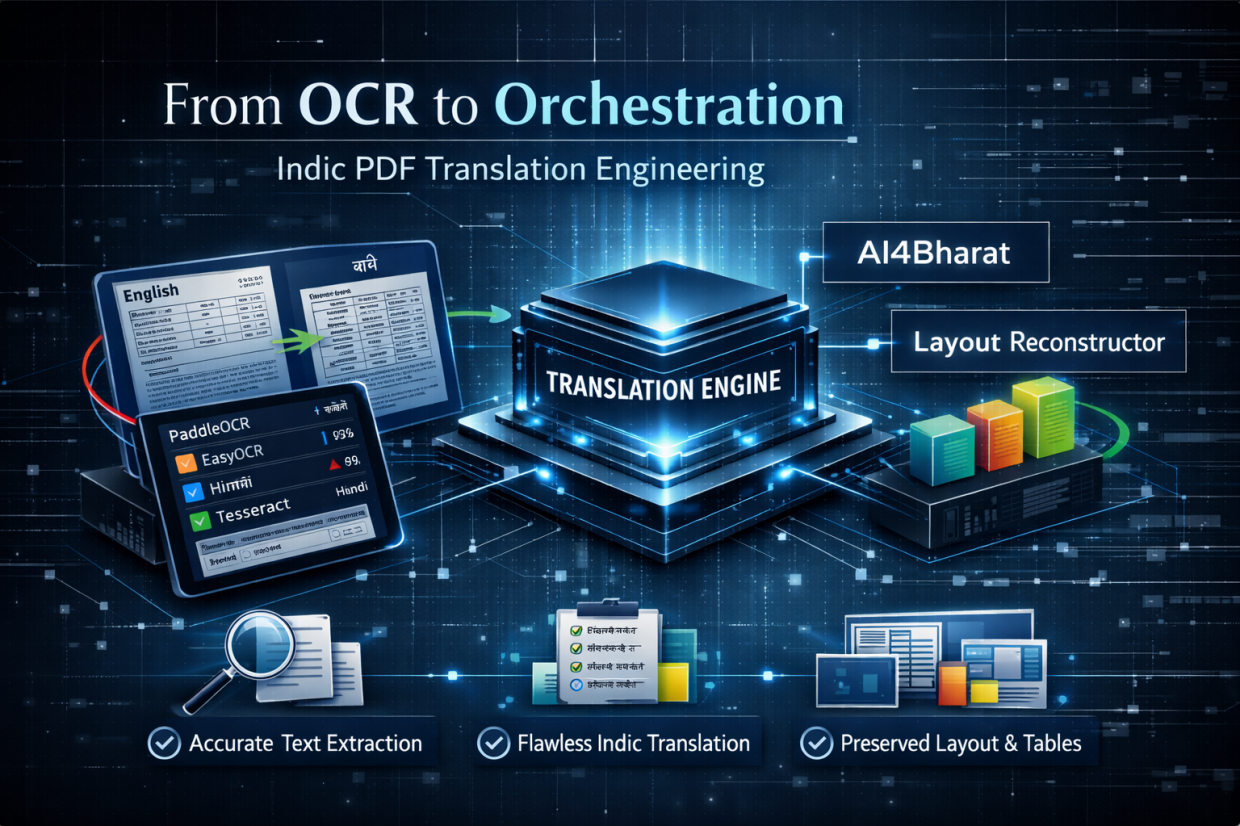
Beyond OCR: Engineering a Layout-Aware Indic PDF Translation Pipeline Engineering challenges often emerge at the intersection of language, structure and automation. One such challenge involved building a system capable of transforming general-language PDFs into Indic languages without losing layout fidelity, structural alignment or visual consistency. On the surface, this sounds like an OCR and translation task. In reality, it became an orchestration problem involving multiple OCR engines, context-aware translation models and layout reconstruction logic working together as a single intelligent workflow. This project represents a shift from simple text extraction toward layout-aware document intelligence, where preserving meaning and preserving structure carry equal importance. The Engineering Objective The core goal was not merely to translate text, but to recreate documents in Indic languages while maintaining the original design integrity. The system needed to: Extract structured content from PDFs using multiple OCR engines Translate English content into Indic languages such as Hindi Preserve bounding boxes and layout positions Reconstruct tables dynamically based on translated text size Prevent overlapping caused by language expansion Unlike traditional translation pipelines, this required deep coordination between AI models and document reconstruction logic, an approach aligned with Swayalgo’s focus on practical AI engineering. Evaluating OCR Models in Production Contexts During development at Swayalgo Technologies Pvt Ltd, multiple OCR frameworks were tested: PaddleOCR EasyOCR Tesseract OCR Each offered unique advantages, but real-world structured documents revealed clear differences. Tesseract OCR – performed well for lightweight extraction but struggled with complex layouts. EasyOCR – provided multilingual flexibility but lacked stability in table-heavy documents. PaddleOCR – delivered consistent bounding box detection and reliable structure awareness, making it the strongest choice for production workflows. The decision to standardize on PaddleOCR came from evaluating not just accuracy but reconstruction reliability. Real-World Challenges and Architectural Decisions Indic Language Expansion One of the most complex engineering challenges involved text expansion. Indic translations often produce longer sentence structures compared to English. When inserted into fixed coordinates, this created: Text collisions Broken table alignment Layout distortion Rather than forcing translated text into rigid boundaries, the system recalculated layout structures dynamically. Context-Aware Translation Early experiments translating line-by-line resulted in poor semantic quality. Translation models require full context, not fragmented lines. To solve this, the pipeline reconstructs logical sentences before translation. This architectural change significantly improved accuracy and readability. Dynamic Table Reconstruction Tables proved to be the most sensitive element. Instead of treating tables as static geometry, the system rebuilds them based on translated content size, ensuring alignment remains visually correct even after language transformation. Pipeline Architecture at Swayalgo The implemented workflow follows a structured orchestration model: Step 1 — Page Banking Each page is indexed with metadata including: Page dimensions Text coordinates Table regions Image positions This creates a structural blueprint for reconstruction. Step 2 — OCR Extraction Using PaddleOCR, the system extracts text blocks and layout data, preserving positional information required for later stages. Step 3 — Sentence Reconstruction Extracted lines are merged into context-aware text segments. Structural noise is removed so that translation models receive meaningful input. Step 4 — Indic Translation with AI4Bharat The AI4Bharat model was selected for its strong performance in Indian language translation. Its contextual understanding allowed the system to maintain semantic accuracy across longer sentence structures. Step 5 — Layout-Aware Placement Translated text is repositioned using recalculated bounding regions. If content exceeds available space, additional pages are generated automatically preventing overlap without manual adjustment. Step 6 — Structural Reconstruction Tables, images and metadata elements are rebuilt while preserving original design intent, ensuring the final document mirrors the source layout. Why PaddleOCR Emerged as the Preferred Engine Throughout iterative testing at Swayalgo, PaddleOCR consistently demonstrated: Accurate layout detection Strong multilingual performance Reliable table extraction Its balance between precision and flexibility made it the most suitable choice for layout-preserving translation workflows. Lessons from Building Layout-Aware AI Systems This project reinforced several broader engineering principles: OCR accuracy alone is insufficient without structural intelligence Translation pipelines must prioritize context over speed Indic language workflows require adaptive layout logic AI systems must be orchestrated, not simply connected Most importantly, real-world AI engineering is less about isolated models and more about how those models interact within a controlled architecture.
Bhashini and AI4Bharat are Building India’s Inclusive AI Future
AI for a Billion Voices: How Bhashini and AI4Bharat Are Shaping India’s Inclusive AI Future India is undergoing a historic technological transformation powered by artificial intelligence. But unlike many nations, India’s defining strength its linguistic and cultural diversity also presents one of its biggest digital challenges. With 22 official languages, over 120 major languages and thousands of dialects, India needs AI systems that reflect its people, its languages and its lived realities. This vision is being brought to life through two groundbreaking national initiatives Bhashini and AI4Bharat and a crucial industry enabler, Swayalgo which is helping organizations put this technology to work on the ground. Together, they are building the backbone of India’s multilingual, inclusive AI future. Bhashini: India’s National Language AI Platform In today’s digital world, language access often defines digital access. Most global AI tools are built primarily for English, which can unintentionally exclude millions of Indian users. Bhashini, India’s National Language Translation Mission (NLTM), is the government’s bold answer to this challenge. What Is Bhashini? Bhashini is not a single app it is a nationwide language AI infrastructure designed to empower researchers, developers, startups, and enterprises. It brings together: Multilingual datasets: Large-scale collections of text and speech in Indian languages. AI models: Advanced translation, speech recognition (ASR), and text-to-speech (TTS) systems tailored to India’s linguistic landscape. APIs and SDKs: Plug-and-play tools that make it easy for anyone to integrate language AI into apps, websites, or services. Bhashini’s mission is simple yet transformative:Make Digital India truly multilingual.Enable every citizen to use technology in the language they are most comfortable with. AI4Bharat: The Research Engine Powering India’s Language AI At the core of Bhashini’s capabilities lies AI4Bharat, an initiative led by IIT Madras and supported by the Government of India.AI4Bharat is both a research lab and an open-source movement committed to building world-class AI for Indian languages. Key Contributions of AI4Bharat IndicTrans & IndicNLP: State-of-the-art translation and NLP systems for Indian languages. Speech technologies: Cutting-edge ASR and TTS models that enable Indian-accented voice interfaces. Open-source datasets: Massive multilingual datasets that fuel innovation across academia, startups, and industry. AI4Bharat ensures India is not just a consumer of AI technology but a creator- building tools for Indian languages, from Indian contexts. Many of Bhashini’s APIs run directly on AI4Bharat’s models, making advanced language tech publicly accessible. Swayalgo: Bringing AI to the Real World While Bhashini and AI4Bharat provide the technological foundation, most organizations still struggle with how to use this technology effectively.This is where Swayalgo plays a pivotal role. What Is Swayalgo? Swayalgo is an AI solutions and consulting company focused on helping businesses adopt and deploy AI in ways that deliver real impact. How Swayalgo Creates Value AI Strategy & RoadmapsIdentifying where AI can drive the most value—automation, analytics, multilingual customer support, and more. Seamless Bhashini IntegrationHelping enterprises use Bhashini’s APIs and AI4Bharat’s models to build multilingual chatbots, voice assistants, content platforms, and internal tools. Custom AI SolutionsFrom domain-specific NLP models to advanced analytics pipelines tailored to business needs. Deployment & ScalabilityEnsuring AI systems are production-ready—secure, ethical, scalable, and aligned with real-world operational demands. Through this, Swayalgo enables companies to move from experimentation to meaningful AI-led transformation. The Synergy: Building an Inclusive AI Ecosystem for India The collaboration between Bhashini, AI4Bharat and Swayalgo forms a powerful ecosystem: Bhashini democratizes access to foundational language technologies. AI4Bharat drives innovation, building cutting-edge, open-source AI for Indian languages. Swayalgo operationalizes the vision, helping businesses deploy these technologies at scale. Together, they are ensuring that India’s AI future is not only advanced but inclusive, accessible and India-first. Conclusion: Toward AI for a Smarter Bharat India’s AI journey is unique. It is not about copying global models it is about creating AI that understands India’s linguistic richness, cultural diversity, and on-the-ground realities. With Bhashini enabling multilingual access, AI4Bharat pushing research boundaries and Swayalgo enabling real-world adoption, India is building an AI ecosystem that truly serves all. AI that speaks your language.AI that empowers your business.AI that helps build a smarter Bharat.
Accelerating Digital Growth with Frappe & ERPNext
When businesses think about digitalizing operations, two key concerns often arise: Will this system truly meet our operational needs? Is it cost-effective, scalable, and compliant with our local regulations? At SwayAlgo, we’ve explored many platforms, and our clear choice for clients is the Frappe Framework with ERPNext. This combination delivers the technical flexibility to build advanced solutions and the operational stability that organizations can trust for the long term — whether in manufacturing, non-profit, or educational sectors. What Are Frappe and ERPNext? ERPNext is built on the powerful Frappe Framework — a modern, open-source platform based on Python, MariaDB, and Node.js. It offers a modular DocType architecture, REST and GraphQL APIs, and real-time updates via websockets. This technical foundation makes it highly adaptable for building tailored systems while ensuring stability and performance. For organizations, this means a single, unified system that can be configured to match specific workflows — without paying for features you don’t use. And because it’s open-source, there’s no vendor lock-in — you remain in full control of your system, data, and future direction. Why ERPNext Stands Out Stable and Reliable – Regular updates keep the system fresh without disrupting operations. Bug-Free by Design – Backed by an active community and strong architecture, issues are quickly resolved. Cost-Effective – No recurring license fees; we can even structure infra costs to start after your first year. Perfect for SMEs – Small and medium-scale industries get enterprise-grade tools without the enterprise-grade price. Scalable – As your business grows, ERPNext grows with you — adding apps, modules, and integrations as needed. Freedom to Choose – With no vendor lock-in, you decide how and where to host, modify, or maintain the system. Tailored for Key Sectors Manufacturing From production planning to inventory tracking, ERPNext streamlines shop-floor processes, reduces wastage, and improves delivery timelines. NGOs Manage donors, track funds, monitor project milestones, and ensure full transparency with stakeholders. Educational Institutions Automate admissions, fee collection, student records, academic schedules, and performance tracking — all in one place. Designed for the Indian Ecosystem ERPNext is not just globally capable — it’s India-ready out of the box. With the India Compliance module, it supports: GST management with automatic IGST/CGST/SGST calculations, HSN code handling, and GSTR-1/GSTR-3B reports. E-invoicing & E-way bills integrated directly into your workflow. TDS processing with automated deductions and reporting. This makes it a natural fit for Indian businesses that need to stay compliant without juggling multiple disconnected systems. Trusted by Leading Indian Companies ERPNext powers the operations of some of India’s most innovative and high-growth companies, including: India’s largest stock broker, managing millions of invoices and transactions seamlessly. Fast-growing quick-commerce player streamlining inventory and operations. State-level e-governance platform using ERPNext for process management. Leveraging ERPNext in internal workflows. These examples show that ERPNext is not just for SMEs — it’s robust enough for enterprises handling massive transaction volumes. The Frappe Advantage for Customization The real magic lies in the flexibility of the Frappe Framework: Rapid Development – New features can be built quickly without long delivery cycles. Multi-Site Capability – Host multiple companies or branches on one server with isolated setups. App Ecosystem – Add features like you install apps on a phone — simple bench commands get the job done. Scalable Infrastructure – From 5 users to 500+, performance stays consistent. At a Glance: Why ERPNext + Frappe Works for Everyone Business Value Technical Strength No license fees, cost-efficient Python + MariaDB + Node.js modern stack India-ready GST, TDS, e-invoicing Modular DocType architecture Flexible and scalable for SMEs & large enterprises REST & GraphQL APIs for easy integration No vendor lock-in, full control Rapid app deployment via bench commands Reliable and stable operations Multi-site support for different entities Why SwayAlgo is the Right Partner Choosing the right tool is only half the story — the other half is choosing the right partner to implement it. At SwayAlgo, we: Map ERPNext’s capabilities to your business processes. Build stable, secure, bug-free systems. Offer continued support so your ERP remains a growth enabler, not a maintenance headache. Your Next Step If you’re evaluating ERP solutions, start with one that’s already proven in India, flexible enough to grow with you, and backed by a partner who understands both technology and business processes. At SwayAlgo, we’d be happy to walk you through a live demo tailored to your industry — whether you’re in manufacturing, non-profit, or education — so you can see exactly how ERPNext would fit your operations before making any commitments.
Zephyr RTOS: Powering the Future of Embedded Systems
In the world of embedded systems, developers are constantly seeking lightweight, scalable, and reliable solutions that can operate within tight resource constraints. Enter Zephyr RTOS — a modern, open-source real-time operating system (RTOS) designed specifically for such needs. Maintained by the Linux Foundation, Zephyr is tailor-made for applications ranging from IoT and wearables to industrial control systems and edge devices. What is Zephyr RTOS? Zephyr RTOS is engineered to meet the demanding requirements of real-time embedded systems. With support for preemptive multitasking, modular architecture, and an integrated networking stack, it provides developers with the flexibility to build highly efficient and responsive applications. Its open-source nature and Apache 2.0 license make it a developer-friendly choice, especially for commercial projects. Key Features Here’s what makes Zephyr stand out: Lightweight and Scalable Can run on devices with as little as 8KB of RAM Real-Time Capabilities Deterministic behavior with thread prioritization Modular Design Use Kconfig to customize and include only what you need Broad Hardware Support Compatible with architectures like ARM, x86, RISC-V, and more Built-in Networking Includes support for Bluetooth, IPv6, LoRa, MQTT, and other protocols Security-First Features like secure boot, memory protection, and stack overflow detection Modern Tooling Uses CMake/Ninja and the west project manager for efficient development Supported Architectures and Boards Zephyr RTOS runs on a wide and expanding variety of development boards and microcontroller platforms, which makes it an adaptable solution for embedded and IoT developers. Its architecture-agnostic nature makes it possible to run it on ARM Cortex-M and Cortex-R-based CPUs, RISC-V, ARC, Intel x86, and experimental support for MIPS and SPARC. Popular microcontroller families like the STM32 series (STM32F4, L4, H7), Nordic’s nRF52/nRF53/nRF91 BLE and cellular SoCs, NXP’s Kinetis and LPC, Microchip’s SAM D and E series, and TI’s CC13x2/CC26x2 are all well supported. Among the most notable and widely-used boards compatible with Zephyr are the nRF52840 DK, STM32 Nucleo-F401RE, FRDM-K64F (NXP), ESP32 DevKitC, HiFive1 Rev B (RISC-V), and BeagleBone Black. In addition, Zephyr targets x86 boards such as the UP Squared board and has partial support for Raspberry Pi boards—particularly Raspberry Pi Pico, which is built around the RP2040 microcontroller (ARM Cortex-M0+ dual-core). Although complete Linux-based Raspberry Pi boards (such as Pi 3/4) normally run Linux, Zephyr can be utilized for bare-metal or RTOS-level development on the Pi Pico, making it suitable for low-power real-time projects in education, prototyping, and production. This broad compatibility enables developers to reach a broad range of applications—ranging from Bluetooth beacons and sensor nodes to industrial gateways and hobbyist boards—utilizing a combined and scalable software stack. Development Made Easy Zephyr’s development process is streamlined to get you up and running quickly. Here’s a typical workflow: Setup your environment by installing the SDK and tools. Initialize your project using ‘west init’ and ‘west update’. Configure your build using user-friendly tools like ‘menuconfig’. Compile and flash your code with ‘west build’ and ‘west flash’. Debug and trace using tools like SEGGER J-Link and GDB. Where is Zephyr Used? Zephyr’s flexibility makes it suitable for a wide variety of use cases: Smart Homes Lighting, security systems, and thermostats Wearables Fitness trackers and health monitors Industrial Automation Sensor networks and controllers Automotive Systems: In-vehicle diagnostics and infotainment Healthcare Portable diagnostic and monitoring equipment Aerospace Lightweight avionics and environmental monitoring Built-In Security & Compliance Security is a top priority for Zephyr. It includes support for secure boot, memory isolation, and encryption. The OS is also aligned with standards like MISRA C and offers tools for generating Software Bill of Materials (SBOM), which helps maintain transparency and traceability. It’s a great choice for projects that require functional safety compliance. Tooling and Ecosystem Zephyr comes with modern development tools and a supportive ecosystem. It integrates with IDEs like Eclipse and VS Code, supports CI/CD pipelines, and includes utilities like Device Tree Visualizer. The project is backed by industry giants such as Intel, Google, and STMicroelectronics, ensuring it evolves with the times. Community and Collaboration The Zephyr Project is fueled by a vibrant community of developers, contributors, and companies. With open governance, active mailing lists, and regular hackathons, it’s easy to get help and give back. Extensive documentation and real-world examples also make it beginner-friendly. Comparison with Other RTOS Feature Zephyr FreeRTOS RIOT OS Mbed OS License Apache 2.0 MIT LGPLv2.1 Apache 2.0 Networking Full Stack Add-ons Full Stack Full Stack Security Strong Limited Moderate Moderate Build System CMake/Ninja Make Custom Custom Modularity High Medium High Medium Commercial Support Available Broad Limited Broad How Zephyr Stacks Up Compared to other RTOSe, Zephyr holds its ground with its full networking stack, strong security features, and high modularity. Unlike some competitors, it offers robust commercial support, making it enterprise-ready. Final Thoughts Zephyr RTOS isn’t just another operating system—it’s a comprehensive platform for embedded innovation. With powerful features, a modern development experience, and community-driven growth, it enables developers to bring their embedded visions to life efficiently and securely.