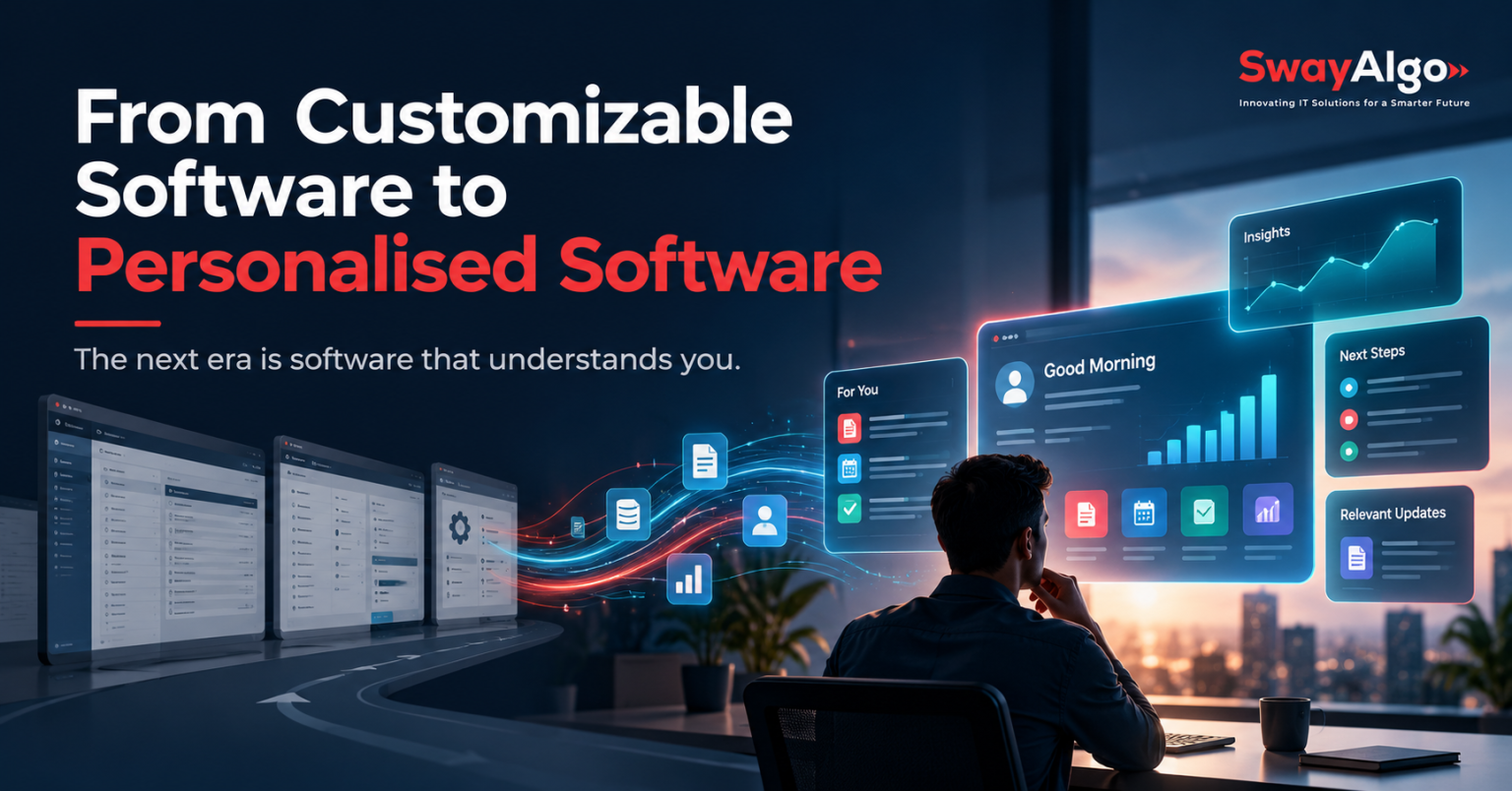
For years, businesses have wanted software that fits the way they work. They have customized applications, configured dashboards and built workflows to meet their needs. SaaS platforms made this easier by allowing businesses to change features and settings without building everything from scratch. But AI is changing what people expect from software. People no longer want to explain the same things repeatedly. They want software that remembers their preferences, understands their needs and helps them get things done. This brings us to a new question: What if software could adapt to us, instead of us constantly adapting to it? Three Eras of Software To understand this change, let’s look at how software is evolving. Era 1: Software We Use Software comes with predefined features and processes. We learn how it works and adjust our work to fit it. Era 2: Software We Customize We change settings, configure dashboards, add modules and create workflows to make software fit our needs. But customization comes with a hidden cost. Someone must maintain those configurations, update workflows, manage exceptions and ensure everything keeps working as the business grows. Over time, the effort required to maintain the software can become almost as important as the value it provides. Era 3: Software That Adapts to Us Software remembers relevant preferences, understands our situation, learns from feedback and helps us make decisions. Instead of relying entirely on manual configuration, it can use current data and context to adapt recommendations, personalize experiences and suggest changes as needs evolve. It can also complete tasks within the permissions we give it. The shift is simple: we are moving from software we operate to software that increasingly understands how we work. The Shift Behind the Shift AI assistants and agents are changing what people expect from digital products. People want tools that remember past conversations, understand their preferences and help them complete tasks without starting from scratch every time. But this change is about more than adding AI to an application. It is about making software more aware of the person using it. Consider an education platform. Two students are learning the same subject. One struggles with fractions, while the other needs more practice with multiplication. A traditional platform might give both students the same lessons. A personalised platform can use their learning history to identify what each student needs and suggest different exercises. As they improve, their learning activities can change too. The platform does more than remember their names. It uses what it knows about their progress to decide what might help them next. The same idea applies to business software. Different people have different roles, priorities and ways of working. Software should be able to account for those differences. This is the real shift: from software that follows settings to software that uses context to make the experience more relevant. But how can software do this well? Why Data and Context Matter Personalization is not just an AI model or a chatbot. It depends on having the right information at the right time. Let’s return to the education example. When a student completes an exercise, the platform records the result. It connects that result to the relevant skill, considers the student’s past performance and identifies what they should practise next. When the student completes another exercise, the system uses the new result to update its understanding. Step by step, the platform builds a clearer picture of the student’s progress. This is where data pipelines become important. They move information between systems, keep it up to date and make it available when needed. The same is true for business applications. An AI assistant cannot give useful recommendations if it lacks the right business data, user preferences or information about what has happened before. Even a powerful AI model has limits when it lacks the context needed to answer a question or take the right action. The intelligence is not just in the AI model. It is also in the system that gives the model the right information and uses its output. The Personalization Layer: Making Software Adapt Data alone is not enough. Software also needs a way to turn that information into a useful experience. This is where a personalization layer comes in. Think of it as an intelligence layer that works across an application. It uses relevant data, user preferences, past interactions and current context to decide what information to show, what to recommend and what actions might help. For example, a business owner might want a quick overview of company performance, while a production manager needs to focus on machine downtime and output. Instead of showing everyone the same information, the software could highlight what matters to each person. Over time, it could also use feedback to improve its recommendations. A strong personalization foundation brings together five key capabilities: Data: Reliable information about users, activities and business operations. Context: Understanding what that information means for the current task. Memory: Retaining useful preferences and past interactions. Personalization: Using that knowledge to adapt information, recommendations and workflows. Feedback and action: Learning from results and completing approved tasks. These capabilities do not have to be separate products or services. They are building blocks that work together. The goal is not to add an AI feature to every screen. It is to make the entire application more useful. Personalization must also be trustworthy. Software should protect private information, respect permissions, and allow users to correct mistakes. It should know when to act and when to ask for approval. After all, software that remembers the wrong thing or takes action without permission can create more problems than it solves. Where Are We Heading? For businesses building SaaS products and digital solutions, this shift creates a new opportunity. At SwayAlgo, we see this direction across business applications, manufacturing, and education. Making personalization work requires more than connecting an AI model to an application. It requires the underlying systems to provide the right information, maintain relevant context and
Coding is a Skill. Building Software is an Art.
At SwayAlgo, we often find ourselves returning to a simple but powerful reflection: Coding is a skill. Building software is an art. Anyone can learn to code. With time, effort, and access, syntax becomes second nature.But the true craft of software lies not in code itself — it lies in understanding people, systems, and simplicity. Why Many Solutions Fail Many digital solutions fail not because they aren’t functional, but because they don’t feel natural. They’re bloated. Over-engineered. Designed with features in mind, not users.And so, adoption dies quietly after deployment. The Art of Building Great Software The art of building great software means doing less, not more. It means listening deeply. It means designing systems that become invisible because they just work. This is where engineering meets empathy. At SwayAlgo, we’re learning that technology is only as good as the clarity behind it. Our Philosophy We want to be more than engineers — we want to be artists of problem-solving. Every line of code we write should reduce friction, not add to it. Every feature should serve a purpose. Every decision should simplify. We’re inspired by the way Steve Jobs thought — how he filtered complexity through clarity.He wasn’t just building products. He was crafting experiences. The kind that feel like magic because someone cared deeply about the details. Building Software That Lasts As we build tools that help institutions modernize, we carry this mindset with us.We’re not chasing trends. We’re chasing understanding. Because in the end, the goal isn’t just to build software.The goal is to build software that lasts. “Simple can be harder than complex. You have to work hard to get your thinking clean to make it simple.” – Steve Jobs At SwayAlgo, this belief guides everything we build. For us, software is not just about code — it’s about clarity, empathy, and impact. We’re on a journey to create solutions that don’t just work today, but continue to evolve and last.