
1. Introduction
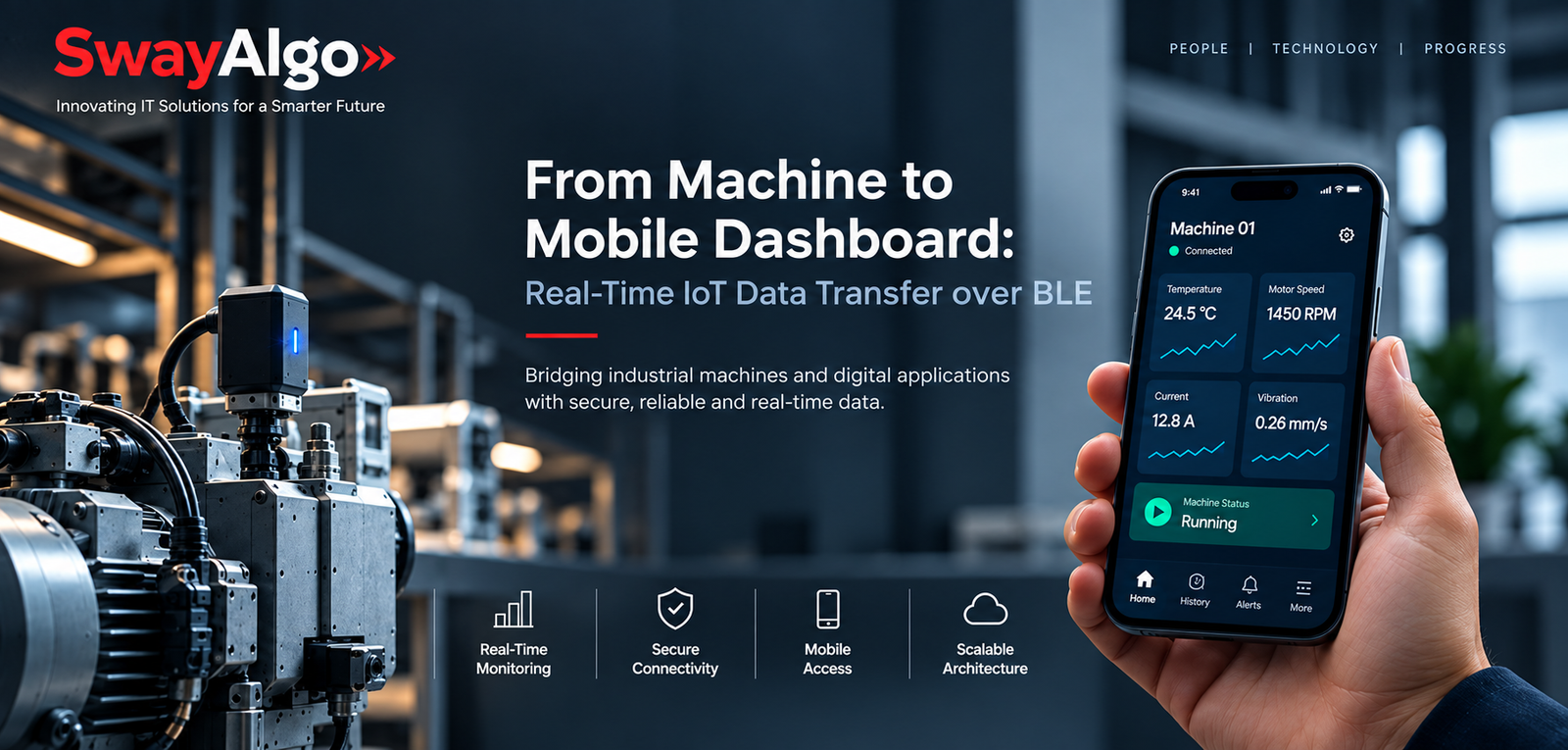
Industrial machines continuously generate valuable data—temperature, voltage, current, RPM, pressure, vibration, machine status and fault information. Traditionally, this information remained within the machine or was available only through a local control panel. IoT makes it possible to bring this machine data into software systems, allowing operators and engineers to monitor equipment in real time.
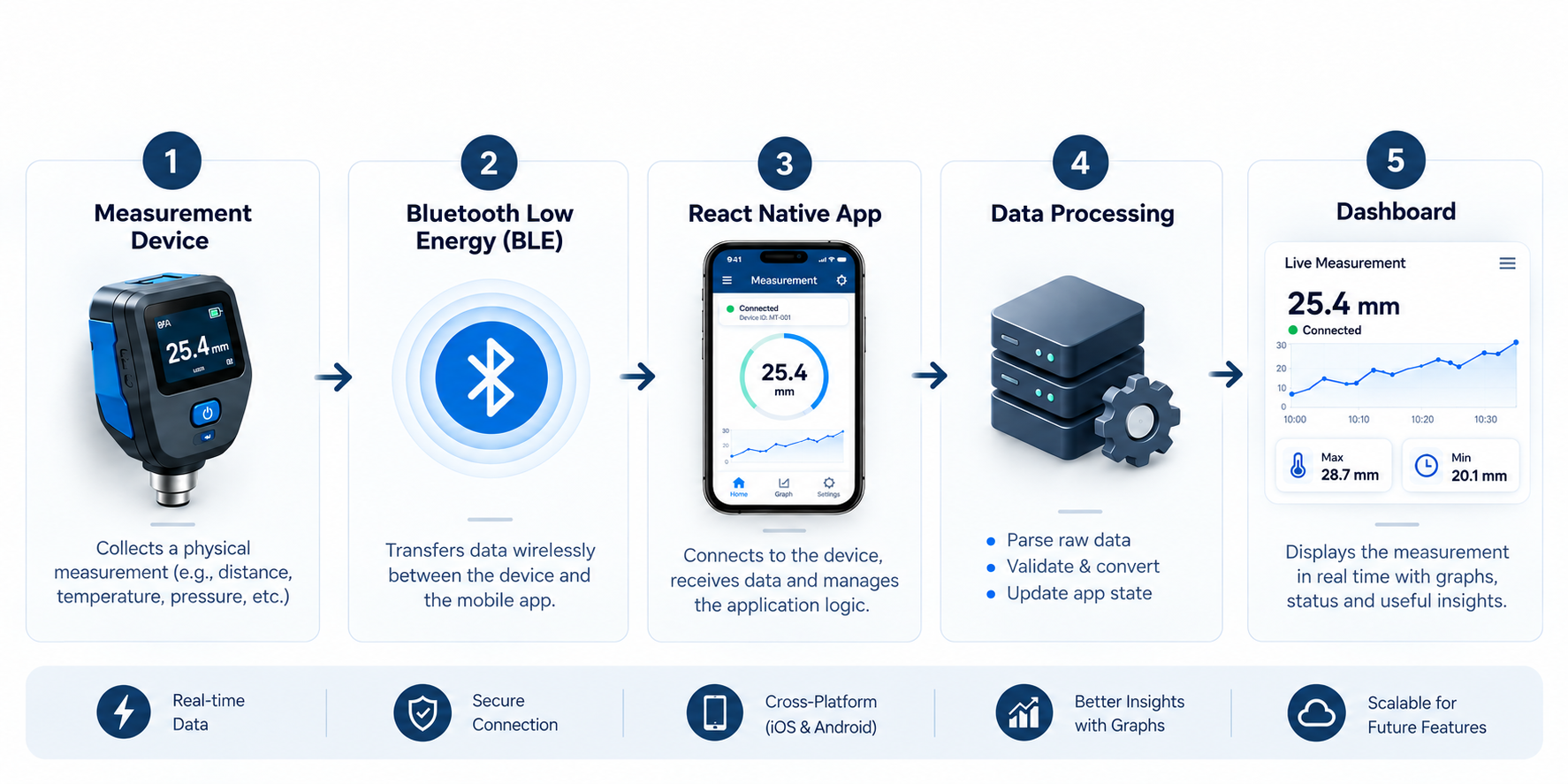
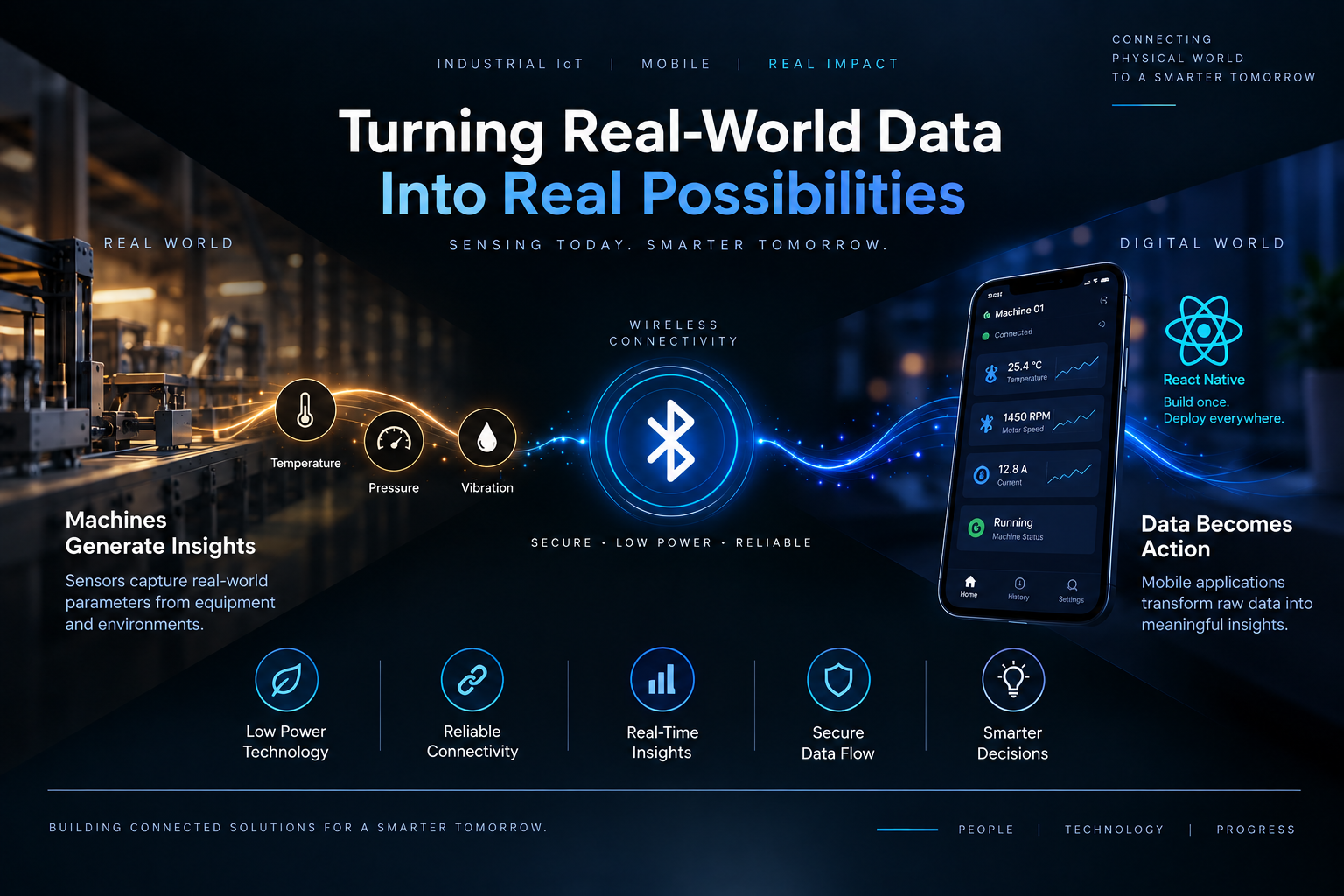
One practical approach is to use Bluetooth Low Energy (BLE) as the communication layer between an IoT controller installed on the machine and a mobile application. In this architecture, the machine collects telemetry through sensors, the controller processes it, BLE transfers the data and a React Native application converts that data into a real-time dashboard.
Machine → IoT Controller → BLE → React Native App → Dashboard
2. From Machine Signals to Telemetry
Every IoT system starts with the physical machine. Before any data reaches a mobile application or cloud platform, the machine must first sense what is happening in the real world. Parameters such as temperature, motor speed, current, voltage, pressure, vibration and machine state are captured using appropriate industrial sensors.
2.1 Sensor Layer
Sensors convert a physical measurement into an electrical signal. Depending on the sensor and machine, this can be:
- Analog signals — voltage or current, such as 0–10 V or 4–20 mA
- Digital signals — ON/OFF, pulse or frequency-based signals
- Communication-based sensors — CAN, Modbus/RS-485, I²C, SPI, etc.
The choice depends on the machine architecture, required accuracy, environmental conditions, cable distance and industrial standards.
2.2 Controller / Edge Layer
The embedded controller acts as the edge-processing layer between the machine and the digital application. Controllers such as ESP32, STM32 and Nordic nRF52 can acquire data from multiple sensors and process it locally before any information is transmitted over BLE.
The firmware is responsible for converting raw electrical signals into reliable engineering measurements. This typically includes signal acquisition, filtering, calibration, unit conversion, range validation and machine-state evaluation. Processing the data at the edge reduces unnecessary communication and ensures that the mobile application receives meaningful values rather than raw sensor signals.
For example, a temperature sensor may provide an analog signal that is sampled through the controller’s ADC. After applying the sensor’s calibration parameters and filtering noise, the firmware may report the resulting measurement as 72.4 °C. Similarly, a motor-speed sensor may generate pulses proportional to shaft rotation; the firmware calculates the pulse frequency and converts it into an engineering value such as 1,450 RPM.
This edge-processing approach establishes a clear separation of responsibilities: the machine and controller handle measurement and real-time processing, while the BLE and application layers handle communication, visualization and user interaction.
Sensor Input | Controller Processing | Output Value | Unit | Validation Rule |
Temperature sensor / ADC | ADC conversion → calibration → noise filtering | 72.4 | °C | -40 to 150°C |
Motor-speed pulse signal | Pulse measurement → frequency calculation → RPM conversion | 1,450 | RPM | 0–6,000 RPM |
3. Why BLE for Industrial IoT?
BLE uses the GATT (Generic Attribute Profile) architecture and provides a practical communication layer when a mobile device needs to communicate directly with a nearby machine. a practical communication layer when a mobile device needs to communicate directly with a nearby machine. It is especially suitable for industrial telemetry because machine data is typically small, structured and periodically updated rather than a continuous high-bandwidth stream.
Features | Bluetooth Classic | Bluetooth Low Energy (BLE) |
Primary focus | Continuous data / audio | Sensors & telemetry |
Power consumption | Higher | Lower |
Data pattern | Continuous streams | Short, periodic data |
Typical use | Audio, speakers, legacy devices | IoT, sensors, machines |
Typical range | ~10 m typical | ~10–100+ m depending on PHY, power & environment |
Key Takeaway
BLE is not the complete IoT system; it serves as the local communication layer between the machine and the mobile application. This makes it well suited for local monitoring, diagnostics, commissioning and machine configuration.
4. Connecting BLE with React Native
The React Native application acts as the mobile interface between the machine and the operator. Using native BLE libraries, the app can discover nearby IoT devices, establish a GATT connection, subscribe to telemetry notifications and display machine data in real time.
For production development, libraries such as react-native-ble-plx and react-native-ble-manager are commonly considered for BLE communication. Supporting libraries such as Zustand / Redux Toolkit can manage telemetry state, while MMKV / SQLite can be used when local or offline data storage is required.
Scan → Discover Machine → Connect → Discover Services → Subscribe to Notifications → Receive Telemetry → Update Dashboard
The BLE logic should remain separate from the UI. A dedicated BLE service can manage device communication, while a telemetry parser decodes incoming packets and the application state layer exposes validated data to the dashboard.
5. Designing the Telemetry Protocol
A telemetry protocol defines the data contract between the embedded device and the software layer. It specifies how machine measurements are represented, encoded, transmitted, interpreted and validated, while remaining efficient for embedded hardware and extensible for mobile and cloud systems.
Data Representation
During development, a readable format such as JSON can be useful for testing and debugging:
{
“temperature”: 72.4,
“rpm”: 1450,
“current”: 12.8,
“voltage”: 415,
“machineStatus”: “RUNNING”
}
In production BLE systems, telemetry may use a compact binary payload to reduce packet size and communication overhead.The firmware and React Native application must agree on the data type, unit, scaling, byte order, field structure and timestamp semantics.
Protocol Reliability
A production protocol should also define how to handle missing, duplicated, invalid or corrupted data. Timestamps and sequence numbers help detect stale or out-of-order telemetry, while validation rules prevent abnormal values from being treated as valid machine data.
A versioned telemetry contract allows the same data definition to remain consistent across the device, React Native app, backend and cloud, making the system easier to maintain and evolve as new machine parameters are introduced.
6. Real-Time Mobile Dashboard
Once telemetry reaches the React Native application, the raw machine data is converted into operator-friendly information. The dashboard should focus on the machine’s current condition rather than simply displaying sensor values.
A typical view may present Machine Status, Temperature, RPM, Current, Voltage, Active Faults and Warnings, with historical trends available when required.
RUNNING · Temperature 72.4°C · RPM 1,450 · Current 12.8 A · Voltage 415 V
A critical design consideration is separating machine state from communication state. If the BLE connection is lost, the application must not assume that the machine has stopped. Instead, it should indicate Communication Lost / Data Stale and preserve the last known telemetry with an appropriate timestamp.
This distinction is essential for building a reliable industrial monitoring application, where incorrect status can lead to wrong operational decisions.
7. Taking the System Beyond BLE
BLE is effective for local machine connectivity, but a production IoT platform also needs reliable cloud communication, security, and recovery mechanisms. A gateway can collect BLE telemetry and forward it to the backend using MQTT or HTTPS, enabling centralized monitoring, historical data, alerts and device management. Bluetooth SIG also defines gateway architectures for connecting BLE devices with IP-based systems.
Security
Security should exist across the complete chain—not only at BLE. Device authentication, encrypted BLE connections, secure API communication, authorization and protected device credentials should be considered from the beginning. LE Secure Connections provides authenticated pairing and encryption capabilities for BLE devices.
Offline & Recovery
Industrial connectivity cannot always be assumed to be available. A gateway or mobile application should temporarily buffer telemetry locally, attach timestamps/sequence numbers and synchronize unsent data when connectivity returns. This prevents temporary network failures from becoming permanent data loss.
Scale
As the fleet grows, the architecture should evolve toward device identity, OTA firmware updates, telemetry retention, monitoring, alerting and fleet management rather than simply increasing BLE connections.
References: Bluetooth SIG Internet Gateway Architecture, Bluetooth LE Security resources and MQTT specifications.
8. Engineering Challenges
The difficult part of industrial IoT is not establishing the first BLE connection; it is maintaining predictable behavior over long-running field operation. Devices disconnect, sensors drift, machines restart, mobile platforms impose background restrictions and network conditions change. Production systems therefore require deterministic recovery, validation, observability and clear state management across every layer.
Security is equally important. Device identity, BLE security, application authentication and backend authorization should be considered from the beginning rather than added later.
9. Recommended Technology Stack
Layer | Recommended Stack | Role |
Hardware | ESP32 / STM32 / Nordic nRF52 | Sensor acquisition & edge processing |
Embedded | C/C++, FreeRTOS / Zephyr | Firmware & real-time control |
BLE | BLE 5.x + GATT | Local telemetry communication |
Mobile | React Native + TypeScript | Operator application |
App State | Zustand / Redux Toolkit | Live telemetry state |
Offline | SQLite / MMKV | Local buffering & recovery |
Cloud / IoT | MQTT + FastAPI / Node.js | Telemetry ingestion & APIs |
BLE Mobile | react-native-ble-plx | Device Communication |
The exact technology should depend on machine requirements, telemetry frequency, number of devices and connectivity conditions.
10. Conclusion
Building a real-time industrial IoT solution is not simply about connecting a machine to a mobile application. It requires a well-defined pipeline across hardware, embedded firmware, BLE communication, mobile software and cloud infrastructure.
The machine captures physical signals, the edge controller converts them into reliable telemetry, BLE provides efficient local communication, and the React Native application turns that telemetry into actionable information for operators. As deployments grow, the same foundation can extend to gateways, MQTT, cloud analytics, device management and fleet monitoring.
The key engineering principle is to design clear interfaces between every layer:
Machine & Sensors → Edge Processing → BLE → Mobile Dashboard → Cloud → Analytics
A strong architecture keeps the hardware reliable, the mobile experience responsive and the overall IoT platform ready to scale from one connected machine to an industrial device fleet.