

Building High-Performance Web-Based 2D Games with WebGL
Overview
Modern web-based games have evolved far beyond traditional browser experiences. With GPU-accelerated rendering technologies such as WebGL and the emergence of WebGPU, browsers can now deliver highly interactive and visually rich gaming experiences directly on the web. Frameworks such as PixiJS and Three.js simplify graphics programming while enabling developers to build scalable and performance-oriented applications.
Understanding the Web Graphics Ecosystem
WebGL serves as the backbone of modern browser-based graphics rendering. As a JavaScript API designed for GPU-accelerated graphics, WebGL enables developers to render complex visual content efficiently without relying on external plugins. Its ability to communicate directly with the GPU allows applications to process large numbers of graphical elements while maintaining smooth frame rates and responsive user interactions. This capability has made WebGL a critical technology for gaming, simulations, data visualization, and interactive web applications.
Why WebGL Matters
WebGL offers substantial advantages over traditional rendering methods such as HTML DOM manipulation and Canvas-based graphics. By shifting rendering operations from the CPU to the GPU, applications can process larger volumes of graphical data more efficiently. This results in smoother animations, faster rendering speeds, enhanced scalability, and improved responsiveness. For game developers, WebGL enables the creation of richer visual environments while maintaining stable performance across a wide range of devices and platforms.
The Modern Rendering Ecosystem
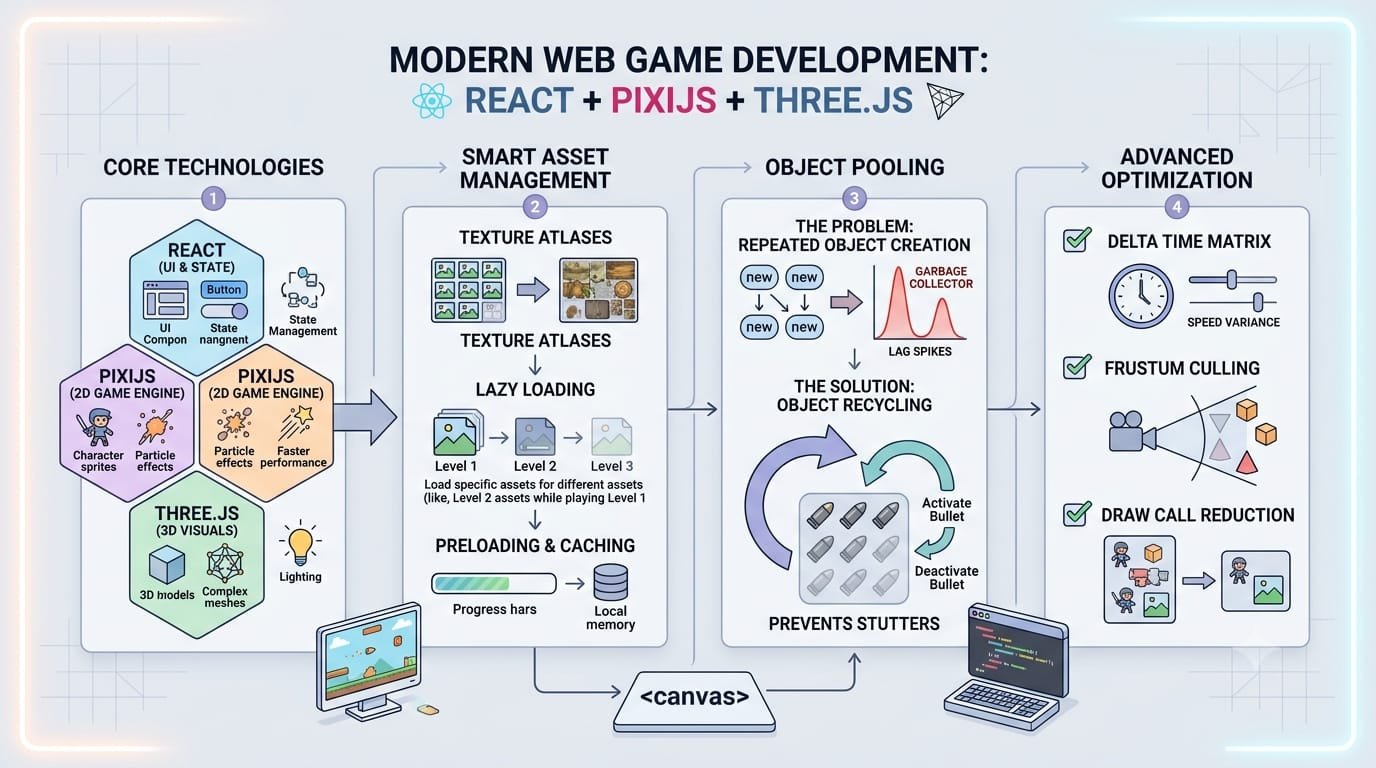
Modern game development typically combines WebGL with frameworks such as PixiJS for 2D rendering, Three.js for 3D experiences, and React for UI management. These technologies reduce development complexity while improving maintainability.
PixiJS for High-Performance 2D Games
PixiJS provides optimized rendering pipelines, texture management, batching, and scene management capabilities. Its lightweight architecture makes it ideal for browser games, interactive applications, and animation-heavy experiences.

Three.js for 3D Experiences
Three.js simplifies the complexities associated with 3D graphics development by offering intuitive abstractions for cameras, lighting systems, animations, geometries, and shaders. Developers can create immersive 3D environments without directly interacting with low-level WebGL code. This accessibility has made Three.js one of the most popular choices for developing web-based 3D applications, virtual experiences, and interactive visualizations.
Building Scalable Interactive Games
Scalable game systems rely on modular architecture, efficient memory management, optimized rendering pipelines, and clear separation of responsibilities between rendering, input handling, audio, animation, and state management.
Asset Optimization and Rendering Pipelines
Texture atlases, spritesheets, dynamic asset loading, adaptive resolution handling, and responsive rendering strategies help improve performance while reducing GPU memory consumption.
React Integration with Game Systems
React is often used to manage HUDs, menus, overlays, dashboards, and other UI elements. Keeping rendering logic separate from UI logic results in cleaner and more maintainable applications.
Advanced Performance Optimization
Techniques such as object pooling, batching, culling, optimized update loops, and draw-call reduction help maintain stable frame rates and responsive gameplay across devices.
Memory Management and Stability
Proper resource cleanup, texture disposal, buffer reuse, and event management are essential for preventing memory leaks and maintaining long-term application stability.
How SwayAlgo Enhances Modern Game Development
SwayAlgo strengthens modern game development through the effective use of technologies such as WebGL, PixiJS, Three.js, React, TypeScript, and modern build tools. The company focuses on reusable architectures, optimized rendering workflows, maintainable code structures, and scalable development practices that improve both productivity and application performance. By leveraging industry-standard libraries, automation tools, asset optimization workflows, and engineering best practices, SwayAlgo helps development teams create efficient, responsive, and future-ready gaming solutions.
Key Focus Areas
- GPU-accelerated rendering
• Scalable architecture
• Efficient CPU-GPU workload distribution
• Memory-safe systems• Real-time interactive experiences
• Performance-oriented rendering pipelines
Conclusion
Modern browser-based games are powered by GPU-accelerated technologies such as WebGL and frameworks like PixiJS and Three.js. When combined with efficient architecture, optimized rendering strategies, and modern development practices, these technologies enable the creation of scalable and highly interactive gaming experiences. SwayAlgo further supports this ecosystem by applying proven tools, libraries, and engineering methodologies that enhance development efficiency and long-term maintainability.